|
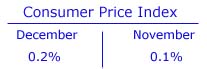
Consumer prices up 0.2%
|
 |
January 14, 2000: 12:50 p.m. ET
December gain less than expected, indicating inflation still tame
By Staff Writer M. Corey Goldman
|
NEW YORK (CNNfn) - Prices at the retail level advanced in December at a slower-than-expected 0.2 percent pace, the government reported Friday, capping a year in which inflation remained benign despite rising energy prices.
The Consumer Price Index, the government's main inflation yardstick, was up less than economists' expectations of a 0.3 percent gain, though above November's 0.1 percent reading. Excluding volatile food and energy costs, prices rose 0.1 percent, also just below expectations.
For the year, inflation rose at a 2.7 percent pace, the Labor Department said, above the 1.6 percent increase recorded in 1998, driven higher by rising energy costs. However, the core CPI, which strips out prices for such fluctuating commodities as gasoline and heating oil, rose 1.9 percent, the slowest gain since a 1.5 percent advance in 1965.
"Clearly the new paradigm is alive and well," said Sherry Cooper, chief economist at brokerage Nesbitt Burns Inc. "While (Federal Reserve Chairman Alan) Greenspan downplayed the policy significance of CPI in his remarks last night, it is still a major positive for investors that core inflation remains benign."
The Greenspan factor
Speaking to the Economic Club of New York Thursday evening, Greenspan suggested the U.S. economy is growing at a pace that will likely need to be reined in with a rate increase, though he hinted that he's not overly concerned about the threat of accelerating inflation.
In fact, the Fed chief singled out the Consumer Price Index as an imperfect measure of prices for goods and services. With the progress of technology and the newfound American wealth based on factors other than just salary, "it's clearly not indicative of what we need to know about consumer inflation," he said.
Even so, investors took the report seriously, interpreting the tame inflation numbers and little sense of urgency from Greenspan about the pace of the economy as a green light to buy.
"What this does is basically vindicate Greenspan's policy," Anthony Chan, chief economist at Banc One Investment Advisors, told CNNfn. "In 2000, we're going to see more of a gradualist policy," though that doesn't rule multiple quarter-point rate increases this year. (296KB WAV) (296KB AIFF)
Markets love CPI
Stocks rallied following the report's release, with both the Dow Jones industrial average and the Nasdaq composite index surging at the open and never looking back. Bonds, which are more sensitive to inflation expectations, took a different tact, initially gaining after the report's release, then reversing course by midday.
Energy prices gained 1.4 percent last month after being unchanged in November. Gasoline prices rose 4.1 percent, leaving prices at the pump a whopping 30 percent higher than a year earlier, the biggest gain since the Gulf War oil shock of 1990.
Food prices rose 0.1 percent last month, while transportation costs gained 0.7 percent. Housing costs climbed 0.1 percent last month, while prices for clothing were unchanged. Prices for new vehicles dipped 0.1 percent as dealers offered year-end incentives to consumers to reduce inventories.
"The report isn't so tame as to deter the Fed from bumping rates another notch, especially with Y2K fears dissipating and consumers showing no signs of fatigue," said Oscar Gonzalez, an economist at John Hancock Securities in Boston. "However, it should ease market fears that the Fed will need to tighten several more times."
Vigilant against inflation
Fed officials have made crystal clear that they are intent on ensuring inflation remains a no-show by keeping a hawkish eye on the progress of the economy, particularly in the form of rising wages in the extremely robust labor market.
Yet even with oil prices doubling last year, with demand overseas for U.S. goods rebounding and with consumer spending on an unstoppable path, overall prices remained remarkably subdued.
Greenspan also made note of the amazing lack of inflation, suggesting Thursday night that the Fed is still struggling to determine just how long advances in technology and productivity can keep businesses from raising prices. "We are groping to infer where those limits may be," he said. "But that there are limits cannot be open to question."
Separately, the Commerce Department reported that business inventories rose 0.9 percent in November after rising 0.2 percent in October, as retailers boosted their inventories in advance of the holiday shopping season and anticipated Y2K demand for supplies, analysts said.
In another report, the Federal Reserve said industrial output gained 0.4 percent last month, the same pace as in November. Capacity utilization, which measures the output of U.S. factories, rose to 81.3 percent from 81.2 percent. 
|
|
|
|
|
 |

|



