|
Romance novels, the facts
|
 |
August 23, 2000: 11:54 a.m. ET
Although they love the work, few romance novelists get rich
By Staff Writer Tatiana D. Helenius
|
NEW YORK (CNNfn) - Author Shirley Hailstock loves the business of romance writing -- but had no intention of becoming a writer when she graduated from college with an MBA in chemical marketing.
Hailstock set her sights on a career in the business world. She worked for pharmaceutical company Bristol-Meyers Squibb (BMY: Research, Estimates) for more than five years, taking highly technology-intensive positions in both systems and accounting.
 She admits that her first book, which came out in 1994, was written on a dare. "I enjoyed reading," said Hailstock, "but I didn't consider writing romance fiction. Then one day, my best friend saw me reading a Harlequin title on our commute to work. I said I could write one myself. So she dared me to. It took me a year -- but I did." She admits that her first book, which came out in 1994, was written on a dare. "I enjoyed reading," said Hailstock, "but I didn't consider writing romance fiction. Then one day, my best friend saw me reading a Harlequin title on our commute to work. I said I could write one myself. So she dared me to. It took me a year -- but I did."
And Hailstock continues to collect on that bet, publishing, on average, two books a year, through BET Books, a print division of BET Holdings.
Pen & Inc.: The business behind the books
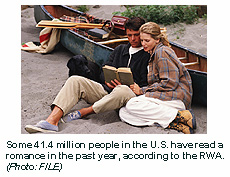
One out of every two mass-market fiction paperbacks sold in the United States this year will be a romance title, according to data compiled by Romance Writers of America (RWA), an industry group.
In hard numbers, that means annual revenues of some $1 billion a year for the industry, in the United States alone, according to sales and publishing statistics compiled by RWA. That's up from $700 million in North American retail sales in 1995.
"Romance fiction is appealing to people because falling in love is an emotion everyone can relate to," said Nicole Kennedy, spokeswoman for the RWA.
 Top romance fiction publishers Harlequin Enterprises, Kensington, Pearson, Dorchester, Bertelsmann and Harper create products with one thing in common -- they start with a story on paper. The process of bringing a title from gamble to romance fiction bestseller depends on a lot of things. Top romance fiction publishers Harlequin Enterprises, Kensington, Pearson, Dorchester, Bertelsmann and Harper create products with one thing in common -- they start with a story on paper. The process of bringing a title from gamble to romance fiction bestseller depends on a lot of things.
"Title acquisition costs have such a wide variance that it is impossible to meaningfully speak of a range," admits Tim DeYoung, vice president of sales and marketing at Dorchester Publishing. "Advances, for example, can run from a flat buyout of $500 to $1,000 to $5,000 to $1 million and above. Each contract," said DeYoung, "will be different, with the inclusion of riders, performance bonuses, and different percentages -- all of these factors combine to alter the advance and future royalties."
 Production kicks in next, with typesetting, cover art and cover design, printing and cost of paper taking a chunk out of the budget. Production costs, with the exception of cover art and design, are fairly standard. The only real variances are the number of pages to be printed, and the price of paper. Production kicks in next, with typesetting, cover art and cover design, printing and cost of paper taking a chunk out of the budget. Production costs, with the exception of cover art and design, are fairly standard. The only real variances are the number of pages to be printed, and the price of paper.
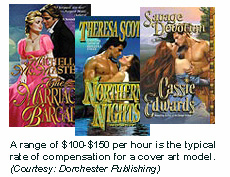
Cover art, however, is another tale: Covers can range from very inexpensive, costing $500 to $750 for book cover design and art, to $10,000 for the art alone. Romance covers featuring models tend to be the most expensive to produce; models just starting out can earn $100 to $150 an hour, with "name" models -- think Fabio -- commanding far greater salaries.
Beyond books: Romance fiction hits the audio trail
Daytime television hunk Gregg Marx made the rounds of both "As the World Turns" and "Days of Our Lives," before launching his own company, Renaissance Productions, which develops audio romance titles.
"After spending five years on daytime soaps," said Marx, "I had a pretty good sense of our audience. My hunch was that many of the same people who were avid daytime fans were also big fans of romance novels."
Marx did some research, and found that, indeed, according to figures compiled by Soap Opera Digest, some 40 million individuals in the United States both watch daytime dramas and read romance novels. And according to Audio Publisher's Association (APA) estimates, annual audio book sales are burgeoning, with total U.S. sales in the audio books niche reaching the $2 billion level in 1999.
Marx decided to concentrate on romance fiction titles largely because "daytime dramas are, in essence, just romance novels taken off the page and placed onto the screen. The two share a common marketing potential."
So in 1997, the actor-turned-entrepreneur roped in show business pals to act as voice talent, acquired a range of titles, and set out to develop a product that would appeal to a huge fan base.
He now oversees the development of a line of 90-minute audio titles, called My Romance, which are carried by Amazon.com (AMZN: Research, Estimates), barnesandnoble.com (BNBN: Research, Estimates), and other online outlets, selling for about $15 per title.
Getting started
Although romance fiction is big business, authors say the work of creating characters and plot lines that sell books isn't always easy. Nor, says popular author Harold Lowry, also known as Leigh Greenwood, is it necessarily all that profitable.
"A writer can get less than a $2,000 advance for a book, or the seven- or eight-figure amounts Nora Roberts and Jayne Ann Krentz get," Greenwood said. "Beginning writers usually get about $2,000 for an historical and $5,000 for a contemporary, and they generally receive additional money in royalties, or their book just could not earn out."
However, for Greenwood, the love of writing is why he got into the business -- also because his wife, an avid reader of romance fiction, refused to write a book in the genre. So Greenwood picked up the pen instead, and some thirty books later, is still at it.
 However, he cautions would-be scribes, "it's hard to get established. And people have no idea how much money it takes to live when you're self-employed. I have to make at least twice what I'd make if I were a salaried employee -- and that doesn't count medical benefits and insurance. But I'm fortunate in that I've never had to hate going to work. The short answer is: I write because I like it." However, he cautions would-be scribes, "it's hard to get established. And people have no idea how much money it takes to live when you're self-employed. I have to make at least twice what I'd make if I were a salaried employee -- and that doesn't count medical benefits and insurance. But I'm fortunate in that I've never had to hate going to work. The short answer is: I write because I like it."
Hailstock agrees. Although she now loves writing, and her books sell well, she says there are very few romance fiction authors out there who rush out to quit their day jobs. Hailstock herself, in addition to being an author, also works as senior manager of sales systems at Bracco Diagnostics Inc., a pharmaceuticals company.
She also, she points out, has full-time responsibility for her two children.
After work, playing mom might entail taking her son to gymnastics lessons, or driving her daughter to cheerleading practice. But somehow, she manages.
"I write between nine and midnight every single night," Hailstock said. "I started writing during that 'off-time' when the children were small, because it was the only quiet time I could find, and now it's just become a discipline for me."
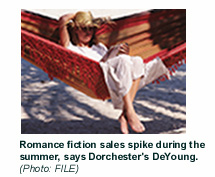 Embarking on a career as a romance fiction author is a lot harder than it looks, Hailstock admits -- and those with families might have to weigh in personal factors. "The first piece of advice I would give an aspiring writer," Hailstock said, "is to realize that writing romance fiction is like any other freelance business. You're not guaranteed any steady income, and generally, advances don't provide you with enough money to support yourself between books." Embarking on a career as a romance fiction author is a lot harder than it looks, Hailstock admits -- and those with families might have to weigh in personal factors. "The first piece of advice I would give an aspiring writer," Hailstock said, "is to realize that writing romance fiction is like any other freelance business. You're not guaranteed any steady income, and generally, advances don't provide you with enough money to support yourself between books."
Some unpublished authors might compromise, said Hailstock, by making dinner at home rather than eating out. Or by giving up the advantages of a dual-earner household so that a spouse can pursue a writing career.
Still, said Hailstock, "it can take years to get published. I'd suggest, before anyone start writing romance fiction full time that they sit down and work out on paper -- right now -- all of their expenses. That includes potential expenses incurred if you left a job that provides medical benefits. Decide what sacrifices you are willing to make, especially in the beginning. Then go from there." 
|
|
|
|
|
 |

|



