|
Barr, AstraZeneca sued
|
 |
May 9, 2001: 8:40 p.m. ET
Drugmakers sued by consumer group for price-fixing of breast cancer drug
|
NEW YORK (CNNfn) - A consumer group is filing a class action lawsuit against AstraZeneca PLC and Barr Laboratories Inc., alleging the companies illegally inflated the generic price of breast cancer drug Tamoxifen.
The Boston-based Prescription Access Litigation project said Wednesday "the defendant companies unfairly and unlawfully cooperated to maintain artificially high market prices."
Under a 1993 pact between the firms, Barr agreed to drop its patent challenge against Zeneca, which had patent protection over Tamoxifen and later became part of Anglo-Swedish AstraZeneca (AZN: Research, Estimates). In exchange, Barr was permitted to distribute the drug in the United States and gain a portion of the sales.
The Prescription Access Litigation Project said the lawsuit against the firms charges that Barr's so-called generic Tamoxifen sells for only 5 percent less than the branded version.
A "true generic" drug would offer a more significant discount, thus encouraging competition, a statement from the consumer group said.
The federal antitrust class action lawsuit was filed on Wednesday in the U.S. District Court for the Eastern District of New York, and lawsuits are being filed in state courts in New York, California, Florida, Massachusetts, New Mexico, Maine and West Virginia, the group said.
Barr (BRL: Research, Estimates) responded with a statement saying it distributes the medicine to drug stores, distributors and wholesalers at about a 15 percent discount to the brand price.
"As a result of our patent settlement, breast cancer patients have had access to a more affordable version of Tamoxifen years earlier than they would have if we had pursued our challenge and failed," said Bruce Downey, Barr's chairman and chief executive.
In Barr's fiscal second quarter ended Dec. 31 2000, the company generated total revenues of $135.2 million, of which $82.7 million came from Tamoxifen.
A generic drug maker can receive the right to be the only seller of a generic version of a particular drug for six months if it successfully challenges a patent on the drug. While generic companies can reap profits from these six-month periods, the price often falls and the number of competitors increases after those six months when a drug goes "fully" generic.
The Federal Trade Commission has recently been investigating pacts between branded and generic drug firms that could prevent generic competition.
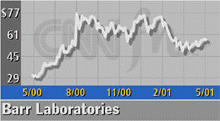
Shares of Barr fell 17 cents to $57.22, while shares of AstraZeneca rose 22 cents to $47.22 on the New York Stock Exchange. 
- from staff and wire reports
|
|
|
|
|
 |

|