|
Industrial production falls
|
 |
July 17, 2001: 10:02 a.m. ET
U.S. industry, hardest hit by slowdown, falls in June for ninth straight month
|
NEW YORK (CNNfn) - U.S. industry continued to suffer in June, the government said Tuesday, as production fell for the ninth straight month.
U.S. industrial production fell 0.7 percent in June, the Federal Reserve reported, after falling a revised 0.5 percent in May. Analysts polled by Briefing.com expected a 0.5-percent drop.
| |

|
|
| |
|
|
| |
Given the size of the inventory overhang in manufacturing and the still-rapid loss pace of job losses, [this report] comes as no surprise.
|
|
| |
|
|
| |

|
|
| |
|
|
| |
Ian Shepherdson
Chief U.S. economist, High Frequency Economics |
|
The Fed also said factories, mines and utilities ran at 77.0 percent of capacity in June, down from a revised 77.6 percent in May. Economists expected capacity utilization of 76.9 percent.
Industrial production has suffered its longest string of declines since the recession of 1982, and capacity use is at its lowest since August 1983, when the economy was coming out of that recession.
U.S. industry has been hardest hit by the slowdown that has gripped the world's largest economy since the second half of last year. While the economy has slowed markedly, manufacturing is in a recession and has lost hundreds of thousands of jobs this year as companies cut production and try to work off their backlog of goods.
"Overall, [this was] another awful report," said Ian Shepherdson, chief U.S. economist with High Frequency Economics Ltd., "but given the size of the inventory overhang in manufacturing and the still-rapid loss pace of job losses it comes as no surprise."
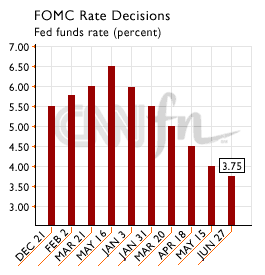
The Federal Reserve has tried to keep consumers spending despite the job cuts by cutting interest rates six times this year.
The production report comes a day after the Commerce Department said inventories at U.S. businesses were unchanged in May after falling more than first thought in April.
Though the inventory data were mixed, analysts hoped it meant companies were slowly beginning to work off their backlog of goods, meaning they could begin to increase production later this year.
"There are a few tentative hints -- higher new orders, a drop in the inventory-to-sales ratio -- that the period of maximum weakness has likely passed," said Steven Wood, economist with FinancialOxygen. "Although further declines in output are anticipated, the rate of decline should gradually diminish."
Click here for CNNfn.com's economic calendar

|
|
|
|
|
 |

|