|
U.S. housing starts rise
|
 |
October 17, 2001: 9:51 a.m. ET
Home building, boosted by low rates, accelerates despite attacks.
|
NEW YORK (CNNmoney) - Construction of new homes rose in the United States in September, the government said Wednesday, as one of the few pillars of strength in the world's largest economy rebounded after last month's terrorist attacks.
Housing starts rose 1.7 percent last month to an annual rate of 1.57 million units after falling a revised 6.7 percent in August to about 1.55 million, the Commerce Department reported. Economists surveyed by Briefing.com estimated that builders broke ground on new homes and apartments at a rate of 1.5 million.
But building permits, a gauge of sentiment among builders about the economy in the months ahead, fell 3 percent to an annual rate of 1.52 million, the Commerce Department said.
"We remain relatively optimistic about the housing market, but we do accept that activity fell sharply in the immediate aftermath of Sept. 11," said Ian Shepherdson, chief U.S. economist at High Frequency Economics Ltd.
On Wall Street, stocks rose in early trading, mostly due to corporate earnings news, while U.S. Treasury bond prices fell.
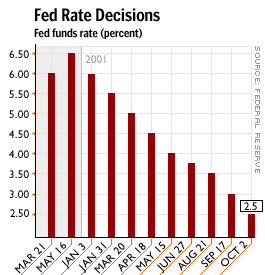
The housing market has remained strong during a slowdown in the broad economy, thanks in part to low mortgage rates. The Federal Reserve has cut interest rates nine times this year to make borrowing easier in a bid to keep consumers spending and avoid a recession.
But many economists think a recession is unavoidable in the wake of the attacks on the World Trade Center and the Pentagon, and the housing market is not immune.
"Like the rest of the economy, the housing market is clearly showing the effects of the Sept. 11 attack on America," said Bruce Smith, president of the National Association of Home Builders, in a survey released Tuesday by the NAHB.
Fifty-six percent of the builders surveyed said new home sales fell after the attacks. The builders blamed sagging consumer confidence, a weak economy, a softening job market and falling stock prices for the slowdown in activity.
Still, the NAHB and many economists expect the housing market to rebound in the beginning of 2002, as continuing low mortgage rates likely will offset some of the negatives in the economy.
Click here for CNNmoney.com's refinancing calculator
"Although the fundamentals have deteriorated builders have been cautious, so there is no imbalance of unsold new homes," said Steven Wood, economist with FinancialOxygen. "Therefore, as long as new home sales are maintained near current levels, housing construction can also continue near these levels."
By region, housing starts jumped 12.5 percent in the West to a rate of 423,000, and they rose 7.6 percent in the South to a rate of 732,000. But in the Midwest, starts plunged by 16.6 percent to a rate of 282,000; in the Northeast they declined by 11 percent to a rate of 137,000. 
- from staff and wire reports
|
|
|
|
|
 |

|