|
Stadium pipeline drying up
|
 |
December 12, 2001: 6:54 p.m. ET
The boom that built 30 new stadiums in five years has quenched thirst for now.
A twice-weekly column by Staff Writer Chris Isidore
|
NEW YORK (CNN/Money) - The stadium building boom seems to running out of steam -- but not for any of the reasons you might expect -- recession, stretched government resources and a general downturn in interest in team sports. Those have proven to be less important than the fact there isn't much demand left.
Consider that sports teams' edifice complex has produced 25 new major league sports venues in just the last four years, with another five due to open next year, leaving the wish list considerably shorter than it was a short time ago.
"Almost everything is done. Most teams have gotten them (new homes)," said Roger Noll, Stanford professor of economics and an expert on the economic impact of new sports facilities.
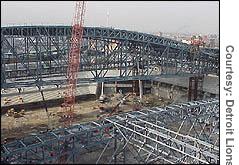
Next year is expected to bring four new football stadiums and a basketball arena. But the pipeline starts to run dry after that. Definitive plans for new sports venue openings drop to four in 2003 and three in 2004, with none confirmed after that.
|
|
|
Work progresses on Ford Field, one of four new football stadiums due to open next year. | |
While some sports teams are seeking new homes from taxpayers in locations such as Minnesota and South Florida, the government officials and voters who have rejected stadium funding proposals in the past seem reluctant to change their mind, even if it means losing a team.
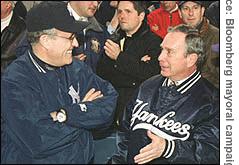
One change that Sept. 11 had on stadium construction is in New York, which had been on the verge of announcing deals for both the Yankees and Mets, and which was also looking at a football stadium to try to woo back the Jets from New Jersey. The baseball proposals were strongly supported by Mayor Rudy Giuliani. But his successor, Mayor-elect Mike Bloomberg, seems far less willing to back new stadiums.
| |
|
|
New York Mayor-elect Mike Bloomberg, right, shown here at Game 3 of this year's World Series with Mayor Rudy Giuliani. Bloomberg does not share Giuliani's support for two new publicly-funded baseball stadiums. | |
"The mayor-elect believes New York City should have the best facilities for its sports teams, yet there are certainly large economic burdens at this time," said Bloomberg spokesman Jerry Russo. "Such development would require substantial private funds and contributions."
But a new basketball and hockey arena is still be in the works in Newark, N.J., at a site virtually in the former shadow of the destroyed World Trade Center. Some sort of new home for the New Jersey Nets and New Jersey Devils has been generally supported by Governor-elect Jim McGreevey, even as debt rating agency Moody's predicts a slowdown in the economy would wipe out the state's $1 billion surplus in the coming year.
Moody's lowered the outlook for the state's general obligation bonds Monday, though that probably won't directly affect McGreevey's proposal to use sales tax collected in and around the arena to pay off arena bonds. McGreevey has not taken a position on offering a new baseball stadiums to either the Mets or the Devils' and Net's co-owners, the Yankees, to try to lure them across the Hudson River.
Waiting for the next boom
Noll said he believes the slowdown in building is only temporary -- but don't expect a quick rebound. "It'll probably be another 10 years until the boom comes back again," he said. "Teams want major renovations every 20 years or so."
Noll also believes one of the drivers of stadium construction -- expansion of sports leagues -- might not be over, even as baseball debates plans to become the first major sports league in more than a century to contract through the closing of two teams.
Click here for CNNSI.com
"By 2005, I would expect there will be expansion in both baseball and football," Noll said. "Even if baseball does contract, I see it as a move to be in control of the relocation process. Major League Baseball could pay $250 million to buyout the Montreal Expos, then sell the expansion rights for a team in Washington or Northern Virginia for $400 million to $500 million."
So sports teams' edifice complex shows no signs of going away, even if fans are forced to "suffer" in parks and arenas almost as old as the athletes who compete in them. Even if we go through a season or two without a taxpayers being asked for any additional subsidies, don't assume tax coffers will be safe in the long term. 
Click here to send mail to Chris Isidore
|
|
|
|
|
|

|


