NEW YORK (CNN/Money) - A closely watched measure of U.S. consumer confidence fell in early September, according to published reports Friday, contrasting with a government report that showed retail sales rose in August.
The University of Michigan's consumer sentiment index for September fell to 86.2 from 87.6 in August, according to a Reuters report. The survey is available only to paying subscribers. Economists, on average, expected a sentiment reading of 88, according to Briefing.com.
The Michigan sentiment numbers and another closely watched confidence measure from the Conference Board, a private research firm, have fallen steadily this summer, but consumers have kept on spending.
"Consumer sentiment numbers are not reflecting economic sentiment, but political or social sentiment," said John Silvia, chief economist at Wachovia Securities. "If you were generating an economic forecast of spending from these numbers, you'd be totally wrong."
Nevertheless, U.S. stock prices fell after the report, though recovering from lows, while Treasury bond prices rose.
The university's current conditions index, which measures how consumers feel about the economy at present, fell to 95.9 from 98.5 in August. The expectations index, measuring how consumers feel about the future, fell to 80 from 80.6.
Consumer spending is closely watched since it fuels about two-thirds of the world's largest economy. Sluggish sales at chain-store retailers such as Wal-Mart (WMT: Research, Estimates) and Target (TGT: Research, Estimates) in August led some economists to worry that consumers were finally beginning to show signs of strain after carrying the economy out of a recession that began in March 2001.
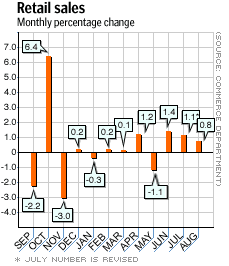
But the Commerce Department said Friday that overall retail sales rose 0.8 percent in August, indicating consumers are still spending despite their worries.
"Consumer confidence is faltering, there is talk of war with Iraq and we have just come through the emotional first anniversary of the September 11th terrorist attacks," said Joel Naroff, president and chief economist of Naroff Economic Advisors. "August should not have been a good month for retailers, but it sure looks like it was."
The contrasting reports continue a recent trend of mixed economic activity that seems to indicate the U.S. economy is having a hard time getting started again following a recession that began in March 2001.
Federal Reserve Chairman Alan Greenspan said Thursday that the Fed needed to cut its outlook for economic growth in 2002 -- though he still saw growth and said there was still plenty of economic stimulus in the pipeline.
Fed policy makers are scheduled to meet on Sept. 24, and most observers think they are unlikely to move their target for short-term interest rates any lower than it already is -- though that possibility still exists.

|