NEW YORK (CNN/Money) -
To give a jolt to the sluggish U.S. economy, the Federal Reserve cut a key short-term interest rate Wednesday more than most analysts expected -- but it also signaled that could be the last cut for a while.
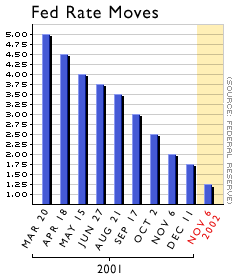
In a unanimous decision, the nation's central bank cut its target for the federal funds rate, an overnight lending rate, to 1.25 percent, a new 40-year low. Most economists expected a quarter-percentage-point cut.
It was the first rate cut of the year, following 11 cuts in 2001. The Fed also cut the largely symbolic discount rate to 0.75 percent.
U.S. stock markets couldn't quite figure out what to make of the decision and the rather strange statement accompanying it, and stock prices rose, fell and then rose again. Treasury bond prices rose.
In its closely watched statement, the Fed said its low target for rates, along with strong productivity growth, should eventually boost economic activity. But it also cited recent signs that economic activity has slowed, in part because of fears about the possibility of a war with Iraq.
"In these circumstances, the [policy] committee believes that today's additional monetary easing should prove helpful as the economy works its way through this current soft spot," the Fed said.
In a completely unexpected move, the Fed also said the risks to the economy were balanced between a risk of further economic weakness and a risk of inflation.
The statement was clearly more of an indication of future policy than an actual statement of risk, even though the Fed officially no longer signals the future direction of monetary policy with a "bias" statement.
"Nobody thinks the risk of inflation is equal to the risks of recession -- all indications are on the down side," said Lehman Brothers chief economist Ethan Harris. "The only way to rationalize this is that [Fed Chairman] Alan Greenspan wanted a half-point cut, and to get a unanimous decision, he had to go to a neutral statement."
Unlike its Sept. 24 decision to leave rates alone, which was met with two dissenting votes, Wednesday's decision was unanimous, apparently part of a concerted effort to present a unified front to the world.
"This probably reflects just how contentious [Wednesday's] meeting must have been," said Wayne Ayers, chief economist at Fleet Boston Financial Corp., a former Fed economist. "Some [policy-makers] felt, 'If we have to ease, we should do it decisively. But, in return, we want a statement of balanced risks, [indicating] we've already done a lot, more than we thought we had to do or should do.'"
While the bigger-than-expected cut seems to hint that the Fed has made its last move for quite a while and almost certainly nixes any chance of another cut at the Fed's Dec. 10 meeting, it doesn't necessarily mean the Fed is averse to moving again if it absolutely has to.
"They'll wait to see how Christmas shapes up, and if it's weak, they'll give another rate cut in January," said Harris of Lehman Brothers.
The Fed cuts short-term interest rates to lower the cost of borrowing and stimulate the economy, and it raises rates to slow the economy down and fight inflation.
Immediately after the Fed's decision, M&T Bank Corp. (MTB: Research, Estimates) cut its prime lending rate to 4.25 from 4.75 percent, effective Thursday. Other banks were expected to follow suit, as they do after most Fed cuts.
At the beginning of the year, many observers expected the economy to bounce back from a recession that began in March 2001 and that the Fed would start raising rates by the middle of 2002 to fight inflation.
But a stock-market selloff, fueled by corporate accounting scandals at Enron and more, along with worries about the possibility of war in Iraq and other woes helped make businesses reluctant to make big investments in production capacity or hire new workers.
As a result, after nearly 1.8 million job cuts in 2001, the labor market has been an open wound in the economy that so far has refused to heal.
Nevertheless, consumers, whose spending makes up more than two-thirds of the total economy, have never stopped spending, thanks in large part to the aggressive Fed cuts last year.
Lower interest rates eventually led to lower mortgage rates, fueling stronger demand for homes, higher home values and a refinancing boom that put more money in homeowners' pockets.
While it was doubtful that a rate cut this week would have much near-term impact on the economy -- Fed actions have a lag of six-to-18 months, according to many economists -- it was still seen as a critical confidence boost to consumers, investors and businesses worried about the economy's direction.
"Since the economy is awash with liquidity and interest rates are already at a [40]-year low, the cut in the interest rate will work primarily through the psychological channel," said Sung Won Sohn, chief economist at Wells Fargo & Co.
Of course, with the fed funds rate very near the rate of inflation -- the 1.25 percent rate is close to the 1.1 percent price deflator used in the third-quarter gross domestic product report -- some economists are worried that the Fed has little ammunition left.
The nightmare scenario for the Fed is a situation in which it's cut rates to the bone, but the economy can't get going -- a situation Japan has found itself in during its prolonged recession.
Wednesday's bigger-than-expected cut might have been meant to give the economy enough of a blast to avoid Japan-style sluggishness, but it could also put the Fed in a risky position.
"I think they're in trouble now if it doesn't work," Sharon Stark, chief fixed income strategist at Legg Mason, told Reuters. "There is not much more monetary stimulus that they can add."

|