NEW YORK (CNN/Money) -
In the mutual fund business there are a few things managers try to avoid. They don't want to lose billions of dollars in assets. They don't want to lose most of their shareholders. And they certainly don't want people calling them senile.
But veteran international manager Jean-Marie Eveillard endured all of those indignities before the '90s Internet bubble burst. Now, however, he's having the last laugh -- he's one of only five overseas managers out of hundreds who has earned a profit in the past three years.
"Famous today, infamous tomorrow," Eveillard deadpanned during a recent interview in his Manhattan office.
What bear market?
The average international stock fund is down 47.7 percent between January 2000 and Oct. 31, compared with nearly 31.9 percent for the average U.S. stock fund. But First Eagle SoGen Global is up about 23 percent in the same time, while First Eagle SoGen Overseas is up 14.6 percent. First Eagle SoGen Gold, a leader in the niche category of gold funds, is up 85.4 percent in the same time, making it the No. 1 mutual fund of the year. (See accompanying chart.)
| * As of 10/31 | | Source: Morningstar |
|
Eveillard, 62, avoided the flameout by steering clear of tech and dot.coms and sticking with so-called old economy stocks. A disciple of famed value investor Benjamin Graham, Eveillard describes himself as a man of caution who hunts for stocks trading at a discount to their "intrinsic value," or what someone would pay today to buy the company in cash.
"There is no mystery to why we are up in the past three years," he said. "We thought people were going bananas with the new economy stocks. But since the bubble has burst, old economy stocks have held their own."
First Eagle SoGen Global (formerly SoGen International), with $1.9 billion in assets, has a go-anywhere investing mandate -- stocks or bonds. He currently has 29 percent of assets in the United States, its lowest level in five years. In the past, the weighting has gone as high as 49 percent.
In U.S. stocks, Eveillard has stuck with the truly unglamorous -- and unloved. His No. 1 holding is U.S. timber company Rayonier, down nearly 14 percent this year. He has $30 million stakes in both conglomerate Tyco International and McDonald's Corp., both trading near their 52-week lows. Tyco is mired in an accounting scandal while McDonald's recently warned about future results and said it would close 175 overseas outlets.
But short-term problems don't bother Eveillard; he considers them opportunities to find stocks at good prices. He even launched a new U.S. value fund in late 2001, First Eagle U.S. Value, which holds most of the same U.S. stocks as do his international funds. The fund is down 3.8 percent this year, putting it in the top 7 percent of its category. (Not to time the market; First Eagle SoGen wanted to complete its product line, Eveillard said.)
"As Benjamin Graham used to say, 'The future is uncertain,'" Eveillard said. "We pay attention to valuation. If the price is right we don't worry too much about the outlook."
Boilers in Germany; bicycles in Japan
At the same time, he said his weightings do not suggest he has less confidence in U.S. stocks. Instead, he's finding better investing ideas in other places. He likes Buderus, a German manufacturer of high-quality appliances that is a well-known brand in Europe. Another top name is Corporacion Financiera Alba, a diversified holding company based in Spain. Eveillard likes the stock because it owns a stake in Carrefour, the second-largest retailer in the world after Wal-Mart. European stocks represent about 22 percent of the global fund, and nearly 40 percent of the $994 million overseas fund.
 |
|
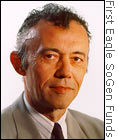
| Jean-Marie Eveillard |
His trademark caution makes it all the more remarkable that Eveillard has more than tiptoed into Japan, which is still struggling to dig itself out of a 12-year recession following an epic bubble economy. Japan represents 11.5 percent of the global fund and 19.5 percent of the overseas fund.
Eveillard admits the Japanese government and society seem to be paralyzed from the collapse of the economy, and the banking system is on the verge of bankruptcy. At the same time, Japan is a highly developed economy, with a well-educated labor force. His top holdings include Shimano Inc., a leading maker of high-end bicycle parts, and Secom Co. Ltd., a provider of security systems.
"After 12 years of a bear market we see many securities that are fairly priced," Eveillard said.
Caution: A hard habit to shake
| Related stories and tools:
|

|
|
|
|
Investors who didn't abandon Eveillard were rewarded for their patience. (Click here to read about how Eveillard survived the late 1990s.) The global fund, which earned a profit in all but one of the past 10 years, has a 10-year annualized return of 10.6 percent. The overseas fund has a five-year annualized return of 9.6 percent. Both funds are ranked first in their categories. Eveillard and co-manager Charles de Vaulx were also named Morningstar's international managers of the year in 2001.
Keep in mind, though, that they are "load" funds, meaning they charge a sales commission. Class A shares of the global fund charge a front-end load of 5 percent of assets, as well as an annual expense ratio of 1.4 percent. And Eveillard plans to retire in 2005. The funds added co-manager de Vaulx about three years ago to ease the transition.
"People tend to believe that whatever is doing well at the moment will always do well," said Scott Kahan, a certified financial planner in New York. "In the 1990s everybody said value investing was dead and never to return, but managers who stuck to their guns obviously proved that wasn't the case."
That said, Eveillard isn't taking anything for granted, as he said so many investors in the '90s had done. He has a 5 percent weighting in gold and mining stocks in both the global and overseas funds as an "insurance policy" against unlikely but still possible events -- the collapse of the U.S. dollar, recurrent recession. Freeport-McMoRan Copper & Gold Inc., up 7 percent this year, is a top holding in both funds (as well as the gold fund.)
"I would rather lose half our shareholders, which we did," he said, "Than lose half of our shareholders' money, which we did not."

|