NEW YORK (CNN/Money) - U.S. consumer confidence improved in November, a research firm said Tuesday, after posting its biggest monthly drop since the Sept. 11 attacks. But the improvement was less than many economists expected.
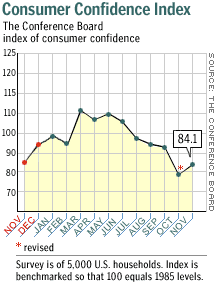
The Conference Board, a business research group based in New York, said its closely watched index of consumer confidence rose to 84.1 from a revised 79.6 in October. It was the first gain for the index following five straight declines, but was below the reading of 85 that economists, on average, anticipated, according to Briefing.com.
The firm's expectations index, which measures how well consumers think the economy will perform in the future, rose to 88.4 from 81.1. The present situation index, measuring consumer's feelings about the current economy, edged up to 77.6 from 77.2.
"The rebound in expectations suggests consumers do not expect economic conditions to become worse," said Lynn Franco, director of the Conference Board's Consumer Research Center. "This comeback, combined with ... upbeat forecasts for Christmas spending, signals a brighter holiday spending season than was anticipated only a month ago."
In a separate report, the Commerce Department said new home sales fell 4.5 percent to an annual rate of 1.007 million units in October, compared with a revised 1.054 million-unit rate in September. Economists, on average, expected sales at a rate of 985,000 units, according to Briefing.com.
The reports did little to help U.S. stock prices, which continued to fall in early trading. Treasury bond prices rose.
Consumer confidence is closely watched by Wall Street and economists since consumer spending fuels about two-thirds of the U.S. economy. Consumer spending has been remarkably resilient despite the recession that began in March 2001, nearly 1.8 million job cuts, last year's attacks, a wave of corporate accounting scandals and falling stock prices.
But confidence had waned in the late summer and fall. In October, the Conference Board index posted its biggest drop since September 2001, and confidence was at the lowest level since 1993.
Many economists are somewhat skeptical of confidence measures, saying they don't always predict the true course of consumer spending. But there was little question that retail sales and other data showed consumers had begun to rein in their spending as the stock market worsened in October.
The end of the stock selloff likely helped bring on the rebound in consumer confidence.
"This increase reflects the upturn in the markets in recent weeks; any further gain in the near-term requires a further firming of stocks," said Ian Shepherdson, chief U.S. economist at High Frequency Economics Ltd.

|