NEW YORK (CNN/Money) -
Feel the pressure? It's likely that some big tech names do following Microsoft's decision Thursday to pay a modest dividend to its shareholders for the first time ever.
Historically, tech players have not paid dividends. In the go-go years of the 1990s, tech stocks soared so far so fast that shareholders didn't bother to think about dividends. Many tech companies instead tried other tactics to boost value -- such as making acquisitions, investing in research and development, or buying back stock.
After three years of capital losses, however, shareholders are beginning to like the idea of companies kicking back some of their earnings, especially because many of the companies have amassed tons of cash and because there is the increasing likelihood that dividends will receive favorable tax treatment under Bush administration reforms.
Until Thursday, Microsoft (MSFT: Research, Estimates), with its $43 billion in cash, was the poster boy for the dividend cause. The company's annual dividend, equal to 16 cents a share before a 2-for-1 stock split it announced at the same time, amounts to a yield of about 0.3 percent based on its current stock price.
As a result, experts say that other tech bellwethers, like Cisco, Oracle and Dell, likely will feel the pressure from shareholders to consider a similar proposition.
"I think that the probability has gone up tremendously," said John Snyder, manager of the John Hancock Dividend Performers fund.
If shareholder pressure isn't enough, the political debate as to whether to eliminate double taxation on dividends could give these companies a shove.
Last week, President Bush proposed a plan to discard the tax in his economic stimulus package. Experts said the possibility that dividends may not be taxed in the near future likely had some impact on Microsoft's decision to offer a dividend, although the company claims it was not influenced by Bush's proposal.
"From a competitive standpoint, before, [generally] technology companies didn't pay dividends. Now they have lost another argument for not paying one," said James Denney, portfolio manager at Mohawk Asset Management. "
The payout
If Dell or Oracle (ORCL: unchanged at $11.44, Research, Estimates) choose to payout dividends, on the same basis as Microsoft, their annual dividend would be a bit lower.

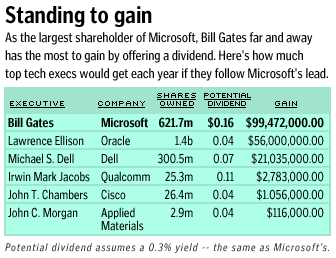
Based on the yield of about 0.3 percent that Microsoft is offering, Dell (DELL: unchanged at $24.83, Research, Estimates) would offer 7 cents per share and Oracle 4 cents.
While it might be small beans for an individual everyday investor, it could be big bucks for a certain CEO or two.
Dell CEO Michael Dell owns 300.5 million shares of his company, according to the most recent proxy statement. Based on a 7-cent dividend, he stands to make about $21 million.
If Oracle paid a 4-cent dividend to its stockholders, CEO Lawrence Ellison would make $56 million, based on his 1.4 billion shares.
By offering a 16-cent payout to his shareholders, Microsoft Chairman Bill Gates just made himself $99.5 million on his 621.7 million shares.
But, industry analysts said this added bonus likely wouldn't influence any decisions.
"To Gates, it's pocket change," Snyder said.

|