NEW YORK (CNN/Money) -
Sure, there are any number of reasons for the three years -- and counting -- of losses in the stock market, and the continuing funk in the economy.
But increasingly, business leaders and policy-makers in Washington are pinning all the problems on just one thing: Iraq.
Sure, there are tensions with North Korea, and worries about terrorism, but in his testimony before Congress this week, Fed Chairman Alan Greenspan focused on Iraq, suggesting that without those worries the economy would be rolling along at a better clip. (See more)
In a conference call announcing quarterly earnings last week, Cisco CEO John Chambers cited "geopolitical" concerns as a main reason for weak technology spending.
But that's just the start. Chambers was just one of many corporate executives pointing the finger at Baghdad.
There are reasons for all the Iraqi fallout. The growing likelihood of a war with Iraq has unnerved millions of Americans -- not to mention millions of Iraqis and others around the world -- and worried people don't buy much.
Or not as much as they usually do, unless they're shopping for bottled water, duct tape, plastic sheeting and the like -- the stuff that U.S. Fire Administrator David Paulison said this week would be helpful after a biological, chemical or radiological attack.
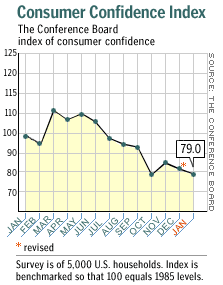
For more on assembling your own duct-and-cover manifest, click here. And for a sense of how the consumer might hold up in the month to come, click here.
On Wall Street, investors are worried, and worried investors don't buy stocks. They buy gold and, to a lesser extent, Treasury bonds, investments perceived as safer in uncertain times.
They also have been buying oil, which is trading at about $36 a barrel in the United States, the highest in two years, on fears supplies would be disrupted further by a war involving Iraq and possibly other Middle Eastern nations. Supplies are already tight because of a two-month long strike in Venezuela, the world's No. 5 producer.
Meanwhile, many investors reckon a quick resolution in Iraq would lead to higher stock prices. But, they could be wrong. Many have been looking at the 1991 Persian Gulf War, and that may not be the right play book. (Full story).
| Related stories
|

|
|
|
|
Then, there are some on Wall Street who say investors actually aren't concerned enough about a possible war with Iraq, which means stocks may have further to fall before those worries are wrung out of the market. (Full story).
But how an Iraq war will turn out, not to mention its after-effects, are really anybody's guess, and some U.S. economists say war or no war, stubbornly sluggish economic growth could actually haunt the United States for years to come. (Full story).
In any event, what should you do with your investments, now that you've got the duct tape, the sheeting, the extra flashlight batteries, and your emergency contact list and evacuation plans updated? Some people say hunker down and do nothing -- war is not a good time to be overhauling your finances. Better to try for a more nuanced approach, click here.
And for a look from one of CNN/Money's columnists at how Iraq might eat your homework, click here.

|