NEW YORK (CNN/Money) -
Napster, much like Michael Corleone, wants desperately to go legit. It didn't work out too well for Michael. Kay left him and he wound up whacking Fredo.
But Roxio, the company that now owns Napster, is hoping that what was once the poster child for music piracy can thrive in the brave new world of legal music downloading.
Roxio acquired Napster's assets at the end of last year with plans of re-launching it as a paid service. It took a big step on Monday with a deal to buy Pressplay, an online music site formed by media companies Sony and Vivendi Universal, for nearly $40 million.
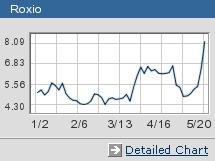
Investors loved the deal. Shares of Roxio surged 17.3 percent on Monday and the stock is up 70 percent year-to-date. But Roxio might find that abiding by the law isn't the most profitable of businesses.
On Monday, the company said that it would spend $20 million on the relaunch of Napster and that it would be a drag on cash flows until it is widely adopted. That's a major concern, considering that as of the end of December, Roxio had just $41.6 million in cash.
To burn or not to burn?
There are plenty of kinks that Roxio will need to work out before Napster returns. Pressplay, which has agreements with the five major record labels to sell their content, operates on a subscription basis.
With the most basic package, users can pay $9.95 a month for unlimited downloads and streaming...but no burning. A $17.95 per month offering allows subscribers to burn 10 songs a month.
That is a dangerous model for Roxio.
For one, it relies heavily on burning software (Easy CD & DVD Creator software for PC users and a similar product called Toast for the Mac). Rolling out a business that doesn't allow users to burn will be shooting itself in the foot.
Plus, Apple has taken the industry by storm with its new iTunes music store, offering songs for 99 cents that users can burn to CDs or transfer to devices such as Apple's iPod.
"Pay per download is the model that will succeed. It doesn't make sense for users to subscribe for a service for songs that they really don't own," said Justin Cable, an analyst with B. Riley & Co, a research firm that focuses on small-cap stocks.
| More about online music
|

|
|
|
|
So far, Apple has tapped only the Mac market. It is developing a version of its iTunes music store for PCs so it will be crucial for Roxio to beat Apple to the punch with the new Napster.
"The challenge for Roxio is not being too late to the market," said Steve Frankel, an analyst with Adams, Harkness & Hill. But even if it wins that race, can Roxio compete with Apple's marketing muscle? Apple has $4.5 billion in cash and has already been blitzing the TV airwaves with prime time ads for the iTunes store.
Old Napster-like sites still exist
Napster will also have to compete with several peer-to-peer file-sharing sites, such as Kazaa, Morpheus and Grokster. Until the music industry can shut down all these sites, piracy will continue to flourish, undercutting pay services.
And a new threat may have emerged on Tuesday. A Madrid-based company called Puretunes claims to have found a loophole in Spanish copyright law that allows it to sell music online without the record labels' permission.
Finally, there's the issue of the Napster brand name. Roxio is betting that Napster has cachet. But will consumers flock to the new Napster, a company that is now aligned with the same corporate fat cats controlling the music industry that the original Napster raged against?
| Recently in Tech Investor
|
|
|
|
|
|
If Roxio can pull it off, selling music online could be a huge boon. Apple said it has sold more than 2 million songs at 99 cents a tune in the first 16 days of the service. That would quickly start to add up for Roxio, which is expected to post sales of $125 million in fiscal 2004.
For now, Roxio is profitable. But Cable and Frankel said management would probably lower estimates for next year when the company's fourth quarter results are released.
"The deal is going to destroy the finances in the near-term. The numbers are going to look horrible and Roxio is probably going to give guidance for huge losses next year," said Frankel, who adds that Roxio might report losses in fiscal 2005 as well.
Napster may not be a thorn in the record industry's side anymore but it may turn out to be one that pricks Roxio.
Analysts quoted in this story do not own Roxio and their firms do not have investment banking relationships with the company.

|