NEW YORK (CNN/Money) -
You can pretty much bet Friday's employment report will be bad -- the only question is what comes next.
Some economists hope the report will mark the end of the bad news for the nation's labor market, which is in its longest slump since World War II, while others worry there's more heartbreak to come.
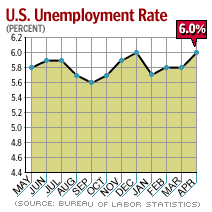
A vast majority of economists expect the Labor Department to say the unemployment rate rose to at least 6.1 percent in May -- the highest level since July 1994 -- and that employers cut tens of thousands of jobs.
Their worries are not unfounded -- most signs have been pointing to a weak report, including:
- weekly jobless claims staying well above the 400,000 level, indicating labor market weakness
- 83 percent of employers plan to cut jobs or hold payrolls steady in the second quarter, according to the latest Manpower Inc. survey of corporate hiring plans
- the number of people who think jobs are hard to get rose in May while those thinking jobs easy to get fell, the Conference Board found in its latest consumer survey
- employers in both the factory and service sectors kept cutting jobs in May, even as business conditions improved, purchasing manager surveys by the Institute for Supply Management (ISM) found
| 
| |

|
|
|
|
|
 CNNfn's Valerie Morris reports on the job market and what you should know if a pink slip is headed your way. CNNfn's Valerie Morris reports on the job market and what you should know if a pink slip is headed your way.
|
|
Play video
(Real or Windows Media)
|
|
|
|
|
|
"I don't think we're back to a stable employment level; we're in for another decline, certainly in manufacturing employment," said Conference Board economist Ken Goldstein. "This should be the best month in the past three, but that's damning with faint praise, given how bad March and April were."
But other economic indicators have improved recently, raising hopes -- on Wall Street, at least -- that the worst might be over for the labor market, which typically lags behind the rest of the economy. Among these:
- both ISM surveys showed business activity recovering well from what most economists say was a war-induced drop in March and April
- Chicago outplacement firm Challenger, Gray & Christmas, which keeps track of corporate layoffs, said May saw the lowest number of job-cut announcements in 30 months
- consumer confidence about the economy's future has been rising, according to surveys by the Conference Board and the University of Michigan.
"I'm hoping that, if we do get bad numbers, the markets may take it in stride and say, 'We know employment is a lagging indicator' and focus on the other things happening that are decidedly positive," said Citigroup economist Brian Jones.
Data revisions could cloud picture
Before investors react to Friday's report, however, they may spend some time scratching their heads about it. The Labor Department is revising the numbers in its surveys of employers' payrolls.
In addition to changing seasonal adjustments and updating benchmark figures, the department is shifting some job descriptions and moving some jobs from manufacturing into services in what it says is an effort to more accurately reflect the current economy.
| Related stories
|
|
|
|
|
|
Economists, on average, expect employers cut 39,000 jobs outside the farm sector last month, according to a Reuters poll, down from 48,000 job cuts in April -- but prior data, going all the way back to 2001, are being revised, so comparisons to prior months might be difficult.
"We expect markets to focus, as usual, on headline hiring and the jobless rate. Whether these figures should be judged according to the usual principles is less clear, however," said UBS Warburg economist Susan Hering in a research note.
Analysts will probably focus on whether the payroll survey more closely reflects the numbers from the department's household survey, which produces the unemployment rate.
The household survey has shown employment growing by about 1.5 million jobs in the past 12 months, contradicting the employer survey, which says payrolls shrank by about 300,000 jobs during that time.
"At labor market turning points, the household survey does better because it picks up self-employed workers and others not reflected in the business survey," said former Federal Reserve economist Wayne Ayers, now chief economist at Fleet Boston Financial. "But I'm still not convinced the labor market is quite as strong as the household data say it is."
How long will the pain linger?
One last time, then, let's review the soon-to-be-obsolete payrolls data: Payrolls have lost 2.7 million jobs since March 2001, when most economists think a recession began. Excluding government workers, payrolls have been underwater for 22 straight months, the longest such stretch since 1944-46.
Ayers doubts the labor market will improve much this year, due in part to productivity gains, which let companies make more goods with fewer workers -- great news for profits, which could boost hiring in the long run. It hurts in the short run, however.
John Silvia, chief economist at Wachovia Securities, noted other reasons employers might be slower than ever to hire new workers, including employee health-care costs and a rising level of overseas production.
He warned that even the Federal Reserve's campaign of cutting interest rates to 40-year lows, as well as the tax cuts recently signed into law by President Bush, might not help create many new jobs, even if they boost the economy.
"If we get increased demand, where is the supply coming from? Is it domestic, or is it imported from Canada, Latin America and Asia? That's still an open question," Silvia said.

|