
NEW YORK (CNN/Money) -
Even during the worst of the bear market, Nvidia was a Wall Street darling -- the stock surged more than 300 percent in 2001.
But it has recently been eclipsed by rival ATI Technologies (ATYT: Research, Estimates) in the hearts of investors. In the third quarter, Nvidia (NVDA: Research, Estimates) shares plunged more than 30 percent, making it the worst-performing tech in the S&P 500; ATI jumped 45 percent.
Both companies make graphics enhancing chips and cards that are used in PCs and video game consoles such as Microsoft's Xbox and Nintendo's GameCube.
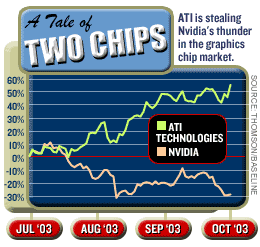
But ATI is now the one with momentum. It announced in late August that it would be providing graphics chips for Microsoft's next version of its Xbox game console, a huge blow to Nvidia, since it was the main supplier for the first Xbox. And earlier this week, ATI announced that it would be the preferred graphic-card provider for Half-Life 2, the most eagerly awaited PC video game of the year.
ATI reported fiscal fourth-quarter results Friday morning, earning 12 cents a share excluding special items, topping analysts' consensus forecast of 10 cents. That's up from the 8 cents it earned on that basis in the third quarter and the essentially break-even results of a year earlier.
Still, it probably makes sense to avoid both companies.
Stocks don't deserve Intel-like valuation
Despite its recent slide, Nvidia stock has a P/E of 25 based on earnings estimates for its next fiscal year. ATI has a P/E of 34. "Valuations are certainly coming into question," said Brian Alger, an analyst with Pacific Growth Equities. "But it's interesting to see the roles reversed since Nvidia used to get the ridiculous multiple."
To put these multiples into context, consider this: Intel (INTC: Research, Estimates) is trading at 27 times 2004 earnings estimates. And when you look more closely at the fundamentals, it's hard to argue that Intel deserves only a slight premium to Nvidia.
| Recently in Tech Biz
|

|
|
|
|
What's more, Intel clearly shouldn't trade at a discount to ATI.
Nvidia reported a gross margin in its most recent quarter of 28.3 percent, and ATI's was 32.9 percent. Intel's? 50.9 percent.
ATI and Nvidia are aggressively jockeying for market share and neither company has been able to take a sizable lead over the other as Intel has done with arch rival Advanced Micro Devices in the microprocessor market. Given how competitive the business is, that makes it tougher for either company to raise prices and, hence, post higher profit margins.
"This is an industry that, if anything, you should assign a discount multiple to other chip companies," said Brian Foote, an analyst with Ryan Beck. "Unlike Intel, neither has a decidedly near-monopoly share."
Tough competition pressures margins
In addition, ATI and Nvidia are both so-called "fabless" semiconductor companies, which means they don't own a manufacturing facility, known in the chip business as a fab. In theory, fabless companies should be able to keep costs down since they are outsourcing the production of their chips.
"Gross margins in the low thirties for a fabless company is subpar," Foote said. To that end, two notable fabless companies in the communications chip market, Broadcom (BRCM: Research, Estimates) and PMC-Sierra (PMCS: Research, Estimates), reported gross margins of 45.3 and 64.8 percent respectively in their latest quarter.
Another factor that investors seem to be ignoring is that Nvidia is far from being dead. While its near-term outlook certainly doesn't look promising, the company recently announced an acquisition of a company called MediaQ, which will boost Nvidia's offerings of graphic chips for higher end cell phones with cameras and color displays. "Nvidia isn't falling that far behind," said Alger.
In addition, my colleague Chris Morris recently wrote about how Nvidia could wind up getting an even more plum contract than ATI's with Microsoft -- the rights to provide chips for Sony's PlayStation 3.
And while that might sound like a reason to go buy Nvidia and sell ATI instead, it actually isn't. It's just another sign that the two companies are going to continue fighting each other tooth and nail for the foreseeable future, which could crimp gross margins for both.
If you're going to pay a premium for a tech stock, the company should have pricing power and a near-stranglehold on its market. Companies like Microsoft, Cisco and Intel do. ATI and Nvidia do not.
Analysts quoted in this story do not own shares of either ATI or Nvidia and their firms have no investment banking relationship with the companies.
Sign up to receive the Tech Biz column by e-mail.
Plus, see more tech commentary and get the latest tech news.

|