NEW YORK (CNN/Money) - Treasury prices traded flat Wednesday despite falling share prices, while a sale of new U.S. debt attracted some demand and active foreign buying ensured yields held near their lowest levels in eight months.
At around 3:30 p.m. ET, the benchmark 10-year note rose 2/32 of a point to 102-10/32 to yield 3.72 percent, up slightly from 3.71 percent late Tuesday, and the 30-year bond gained 1/32 of a point to 110-24/32 to yield 4.67 percent, unchanged from Tuesday.
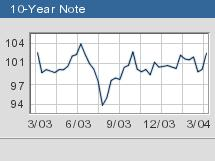
The two-year note shed 1/32 to 100-7/32 to yield 1.51 percent and the five-year note was unchanged at 101-18/32 to yield 2.68 percent.
In the currency market, the dollar traded in mixed ground against the euro and the yen. The euro bought $1.2250, down from $1.2291 late Tuesday, and the dollar purchased ¥110.75, down from ¥111.45 late Tuesday.
The government sold $16 billion in new five-year notes for a high yield of 2.695 percent, which was down from February's 2.84 percent but above the average of 2.36 percent from the previous five auctions.
The surge in Treasury prices following last Friday's unexpectedly weak February employment report curbed some demand for the new paper, but investors still bid for 2.47 times the amount of notes on offer.
Indirect bidders, which include customers of primary dealers and foreign central banks, snapped up some 44 percent of the sale, beating the 42 percent taken in February.
Heavy interventions in the currency market have left Asian central banks, especially the Bank of Japan, with large amounts of U.S. dollars, which wind up parked in Treasuries. But domestic investors seemed to be active in this month's sale.
"What you have to look at is what has been occurring in the foreign exchange markets. They (Bank of Japan) were rumored to be significant buyers on Friday and Monday, the (Treasury) market was bid up on Friday and Monday, so there's a very big risk that they've already put that money to work," said Barclays Capital debt strategist Gemma Wright.
"We've seen domestic demand for the five-year sector since last Friday. Basically, it's either a convexity-related bid or it's the investors buying benchmark duration issues," she said.
Bond prices have surged since data last week showed job growth in the U.S. remains sluggish, which means official interest rates are unlikely to rise this year.

-- from staff and wire reports
|