NEW YORK (CNN/Money) -
Deflation no longer threatens the U.S. economy, Fed Chairman Alan Greenspan said Tuesday, a possible hint that the nation's central bank is closer to raising its target for a key short-term interest rate.
Greenspan, speaking before the Senate Banking Committee, said corporate pricing power was "gradually being restored," after a long stretch in which economists worried about the prospect for falling prices, or "deflation," which could cripple corporate profits and hurt the economy.
"Threats of deflation, which were a significant concern last year, by all indications are no longer an issue before us," Greenspan said in response to a lawmaker's question. "That clearly is a change that's occurred in the last number of weeks, and it's a change ... that's been long overdue and is most welcome."
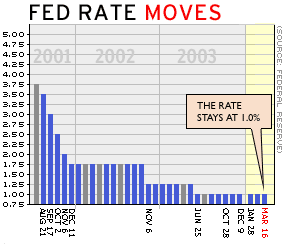
Fed policy-makers are scheduled to meet on May 4 to discuss the economy's health and set their target for the federal funds rate, an overnight bank lending rate that influences other rates throughout the economy. In recent years, with deflation worries in mind, the Fed slashed its target for the fed funds rate to the lowest level in more than 40 years.
But many analysts and investors now believe the Fed will reverse course at its meeting in August, based on a recovering labor market and signs of inflation.
| Related stories
|

|
|
|
|
Some will likely take Greenspan's comments Tuesday as confirmation of that course, and they could even begin to expect an earlier rate hike -- especially if Greenspan makes similar comments in his scheduled testimony before the Joint Economic Committee Wednesday morning.
"We now are on formal rate hike watch," said Robert Brusca, chief economist at Fact and Opinion Economics in New York. "Hope the Fed has this one right because this admission will hike [bond] rates."
Sure enough, Treasury bond prices fell as Greenspan spoke, near the end of the trading day, and yields, which move opposite to price, rose to their highest levels in eight months. U.S. stock prices also fell; stocks typically do badly during Fed rate-hiking campaigns.
Most market participants hadn't expected Greenspan to say anything significant about the economy until his JEC testimony Wednesday morning. Greenspan promised to speak in greater detail about the economy and prospects for inflation in that testimony.
Productivity growth still strong
On Tuesday, Greenspan said he thought the economy seemed to be improving, citing stronger retail sales, motor vehicle sales and orders for manufactured goods.
"It's more anecdotal than statistical at this point, but the anecdotes are fairly convincing," he said.
But he also said labor costs -- the biggest component of consumer price inflation -- were well-contained, a sign he wasn't concerned about runaway inflation.
"Inflationary pressures will be reasonably well contained, so long as productivity is moving at a reasonably good clip," Greenspan said in response to a lawmaker's question.
In fact, he said unit labor costs are still falling, but at a slower rate than they had been during the labor market slump, the longest since 1939.
Despite job gains in recent months, payrolls still have not fully recovered from a slump in hiring and business spending following the bursting of the late-1990s stock-market bubble, the 2001 recession and terror attacks, two wars and corporate scandals.
Wage growth, too, has been slow to recover, helping companies offset the rising costs of oil, steel, lumber and other commodities, while companies are still managing to milk more output from fewer workers, Greenspan said.
"Productivity patterns are still quite impressive and not fully understood by us," he said. "We know what's happened and why, but it's hard to project into the future how this will be resolved."
Some analysts believe the Fed can raise rates and still keep its long-standing promise to be "patient" about making its policy less accommodative to economic growth. This could be accomplished by raising rates slowly, rather than by making several rate hikes in succession, as the Fed did in 1994 and 1999-2000.
"The target fed funds rate is so low that it could be a little bit higher and the policy would still be very accommodating," Dallas Fed President Bob McTeertold CNNfn Tuesday morning.

|