AMSTERDAM (CNN) -
OPEC finished an informal meeting without a recommendation on oil output policy.
Ministers attending the meeting said they did not discuss a Saudi Arabia proposal to raise cartel quotas by at least two million barrels a day.
OPEC is "deeply concerned" about high world oil prices and wants to calm the market to support global economic growth, OPEC President Purnomo Yusgiantoro said in a statement released on Saturday. However, he told reporters that while the oil cartel had not reached a decision on output policy, the informal talks in Amsterdam offered "a view to work toward consensus."
When the group meets formally in Beirut on June 3, Purnomo said the ministers will "do what we can do to assure market stability."
U.S. Energy Secretary Spencer Abraham, after meeting with the Saudi oil minister and several others, said "strong action is required" to bring down oil prices -- which would translate into lower gasoline prices.
Record gasoline prices are vexing American consumers, and have spiraled into a key campaign issue for President Bush. Abraham said he sees as "positive" word that OPEC was discussing increasing quotas.
The Organization of Petroleum Exporting Countries produces about 40 percent of the world's oil and controls about two-thirds of the world's oil reserves, according to the US Energy Information Administration. Its members include Algeria, Indonesia, Iran, Iraq, Kuwait, Libya, Nigeria, Qatar, Saudi Arabia, the United Arab Emirates, and Venezuela.
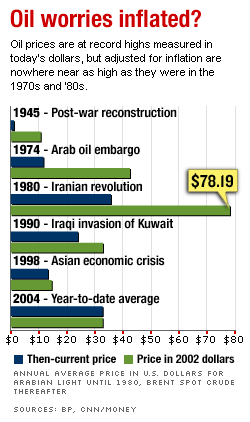
"The ministers noted that current high oil prices are the result of a combination of many factors," Purnomo said in his statement. "Principal among them are gasoline bottlenecks in some regions of the world, increased geopolitical tensions in some regions, speculation in the futures market and recent upward revisions in global demand. These factors were analyzed with a view toward finding a solution to the problem."
OPEC estimates world markets are absorbing 2.3 million bpd more than existing official producer limits of 23.5 million. Producers face heavy pressure from big petroleum importers who fear rising energy costs could stunt world economic growth.
Ministers from the Group of Seven top industrialized nations, meeting this weekend in New York, have said they want swift OPEC action.
On Friday, Saudi Arabia -- the world's largest oil producer -- announced it was prepared to increase its individual oil output to more than 9 million barrels a day in an effort to calm turbulent oil markets.
Iraq's Oil Minister Ibrahim Alolom said his country backed the measure "aiming at the restoration of market stability and calming oil prices."
However, Venezuela's Oil Minister Rafael Ramirez Friday said his country still opposes any increase in OPEC oil supply, saying it would not help alleviate the recent spike in oil prices.
Oil prices closed below $40 for the first time in 10 days Friday, after Saudi Arabia proposed the increase -- a much bigger increase, 8.5 percent, than had been expected.
"The recent increase in oil demand and supply projections for the coming months point to an increase in required production from OPEC by an excess of two million bpd," Saudi Oil Minister Ali al-Naimi said in a statement.
Naimi said Saudi Arabia had already allocated its customers more than nine million bpd crude for June. This is far in excess of the kingdom's official quota of 7.63 million bpd.
"If we find that people want more than nine, we will make available more than nine," Saudi Arabian foreign affairs adviser Adel al-Jubeir told reporters in a conference call on Friday. "Nobody is going to be turned back if they want Saudi crude."
The head of the International Energy Agency said oil consuming nations must share the blame with OPEC for a price scare that threatens to put a brake on world economic growth.
IEA Executive Director Claude Mandil said Saturday poor energy efficiency and limited refinery capacity had helped stoke fuel price increases, as well as OPEC supply restraints.
"I would not say that they, OPEC, are responsible for all of it. We consumer countries are in responsible in part," Mandil told Reuters in an interview ahead of a conference between oil producing and consuming countries.
"It is true that refining capacity is stretched. It is true that there is a refining bottleneck and it is true the demand increase has been stronger than expected."
The Paris-based IEA advises 26 industrialized nations on energy policy.
-- from CNN Correspondent Jim Boulden and wire reports

|