SALEM, Ore. (CNN/Money) – That the world has grown smaller is as plain as labels on the foreign products we buy and as clear as the stilted English of people answering our customer service calls from the other side of the world.
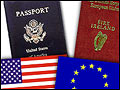
Here's a product of globalization that isn't as easy to spot: the dual citizen.
He's the guy on the plane who was born and raised in Akron but flashes his Indian passport at customs in Mumbai. She's the lucky college grad who gets a trip to Europe and an EU passport to boot. They are the retirees who relocate to Ireland to trace family histories and receive national health benefits.
About 40 million Americans are eligible for dual citizenship in another country, usually because of family ties, according to Stanley Renshon, a professor of political science at the City University of New York and fellow with the Center for Immigration Studies.
Just how many of them are card-carrying (make that passport-carrying) dual citizens is virtually impossible to estimate. But many immigration experts have a hunch the number is increasing.
"This is a sufficiently new enough issue that there isn't any reliable data on this," said Noah Pickus, an immigration expert with Duke University's Sanford Institute of Public Policy. He notes that individuals who apply for dual citizenship don't have to report this to the U.S. government.
Legally, dual citizenship is more feasible than ever, said Peter Schuck, a professor of immigration and citizenship law at Yale Law School. This change began in 1967 when the U.S. Supreme Court struck down U.S. laws forbidding dual citizenship. It has gained momentum over the past decade as countries have changed their laws to allow citizens, former citizens, their children and even grandchildren and great grandchildren to carry more than one passport.
"By my count, 93 countries allow some form of dual citizenship," said Renshon. That's more than double what it was ten years ago by Pickus's estimate.
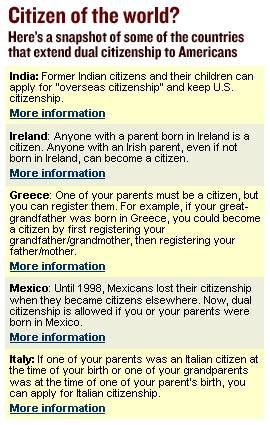
Notably, in 1998 Mexico changed its law to allow Mexican nationals and their children to be dual citizens of Mexico and their adopted countries. India changed its law in 2004. South Korea is considering do the same, according to Renshon.
"Mexico used to have derogatory terms for people who went north," Pickus added. "Now countries have an economic and political interest in hanging onto their citizens. You even see candidates from Mexico and other Latin American countries campaigning here."
What every jetsetter needs
According to Pickus, Americans in the market for a second passport tend to be high-income professionals with the wherewithal to navigate foreign bureaucracies and hunt down the many documents needed to claim citizenship by birth.
"It's not a very easy procedure," said Eda Klotsa, with the Greek Embassy in Washington D.C. You can become a Greek citizen if, say one of your great-grandparents, was born in Greece, she said. But you would first have to apply for citizenship on behalf of that grandparent and parent.
"If your father is Greek, it's easy," she added. "If your great-grandfather was Greek, it's not so easy."
In 2003, the Irish consulates in the United States received more than 3,700 applications from people seeking Irish citizenship via their grandparents, said Joe Hackett, a spokesman at the Irish Embassy in Washington D.C.
Some people are just looking for a sense of connection to their heritage, he said. "Then there are people who may share that view but are also interested in using [Irish citizenship] for practical reasons." Those practical reasons include the right to live and work in Ireland and the rest of the European Union, not to mention the simple convenience of speeding through the EU customs lines.
Of course, citizenship isn't just about shorter lines at the airport or extended vacations in Europe.
To that end, there are critics of dual citizenship. Even the U.S. State Department says that the government does not encourage dual nationality because of problems it may cause. For example, the U.S. government may not be able to assist you as readily if you run into trouble while in a country that considers you its own.
Renshon, who is working on a book titled "The 50 percent American: National Identity in the Age of Terrorism," to be published next year, is also a critic.
At the very least, he said, Congress should restrict people from voting in more than one country. "They should be given a choice that if they vote there, they can't vote here," he said.
Citizenship shouldn't just be about convenience, said Pickus. Then again, there are plenty of Americans who don't take their one citizenship seriously, he added.
"The real risk would be if these people lost their connection with the U.S.," he said. "My concern would be the person who says, 'Why should I vote for higher taxes when I'm a citizen of the world?'"

|