NEW YORK (CNN/Money) -
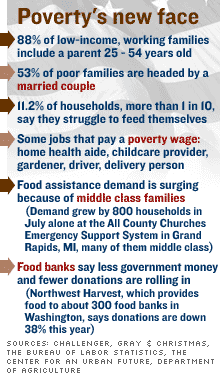
Being poor doesn't mean being jobless, said a recent Challenger, Gray & Christmas report that found more and more working families are living at or below the poverty line.
"Poverty and hunger are rapidly becoming a workplace issue... if for no other reason than the fact than an employee who is worried about where his or her next meal will come from is not going to be very productive," said John Challenger, company CEO, in a statement.
But that's just the job placement firm's assessment.
"There is no mandate for corporations except for the minimum wage, (which is set at $5.15 an hour). After that, the issue's up to the ethicists," said William Dickens, a labor economist with the Brookings Institution.
Some labor economists say altruism could hurt bottom lines, which eventually hurts workers. For example, if a company raises minimum pay, its costs could rise and leave it vulnerable to competitors who pay less.
Several economists, labor activists and legal analysts also agreed that placing the welfare of American workers at the mercy of corporate largesse is dangerous for employees because of what Federal Reserve chairman Alan Greenspan has dubbed Wall Street's "infectious greed."

"But like with anything, there is a low road and a high road," said Jared Bernstein, a labor economist at the EPI. "You can be profitable by squeezing your work force, offshoring and giving workers poor conditions, but it's not stable and it's time limited."
Bernstein said studies have shown that the "high road" -- which amounts to living wages that are usually higher than market wages, benefits and job security -- makes a more productive workforce and is as profitable as a firm run on poorly-treated, part-time labor paid so little they can't feed themselves.
"The bottom line is that it's better to run a workforce on security than insecurity," Bernstein said.
Regulatory holes
The problem of working poor is also a problem of wealth distribution within a company, said Louis Malizia, assistant director of the International Brotherhood Teamsters' Office of Corporate Affairs.
For example, the Economic Policy Institute, a Washington D.C. think tank, says only 15 percent of workers at the bottom fifth of the pay scale have pensions; while 71 percent of the top fifth of workers have pensions.
"That's the mindset we're trying to fight. The gap is much too large between executive and mainline worker pay," said Malizia.
"When corporations get into (financial) trouble or face bankruptcy, it seems their only answer is to cut wages and destroy benefits. Making workers forgo living wages and benefit security is an untenable way to guarantee quality service," added Malizia.
Unions, organizations workers once turned to for protection, are losing strength as major companies like Wal-Mart openly discourage them. But Malizia says it doesn't change the fact that workers have the right to organize.
"It will take, among other things, changes in government to make workers feel secure enough to exercise this right," he said.
Several economists believed that the current administration is not doing enough to protect workers, if not weakening their rights.
"The government should be actively enforcing the high road," the EPI's Bernstein said, adding that this is not currently the case.
EPI information also shows that corporate taxes are at an historic low and that more and more large corporations are being accused of flagrantly violating overtime and worker's compensation laws.
Consumer boycotts and shareholder pressure are another method being used to pressure companies to take the high road.
"A recent, though still small trend, is shareholder activism," said Brossman. "Churches, unions, benefit funds – several groups are introducing shareholder proposals that deal with social issues, pressuring the board to be a better company by saying that social responsibility is a form of profit, and one they believe is important."
"This is not a legal issue only," said Brossman. "It's a test of our society and evidence of what American values are."

|




