|
Will the Fed go too far?
Strong first-quarter GDP growth could spur the central bank to overshoot on rates, stunting growth.
NEW YORK (CNNMoney.com) - Economic growth in the first quarter could be the silver cloud with the dark lining. As the government prepares to release its final reading Thursday on the economy's sluggish fourth-quarter performance, economists are gearing up their forecasts for first-quarter growth, with many expecting a huge growth at an annual rate of 5 percent or more, which would be the second-best quarter in six years.
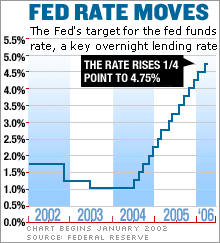
Since the summer of 2000, when the last recession started, only one period -- the third quarter of 2003 -- has seen growth above 4.3 percent. But some economists are also saying that level of growth in gross domestic product (GDP), the broadest measure of the nation's economy, could keep the Fed raising interest rates, perhaps too far. Another Fed rate hike in May is widely expected, and some economists are saying the central bank will raise short-term rates yet again when its policy-makers meet in June, taking its key short-term rate target to 5.25 percent, which would be highest in five years. "How does the Fed step aside with GDP exceeding 5 percent?" said Rich Yamarone, director of economic research at Argus Research, who forecasts 5.2 percent growth in the first quarter and the Fed eventually taking its target for the fed funds rate, an overnight bank lending rate, as high as 5.5 percent. But other economists argue that even with growth above 5 percent in the first quarter, the weak fourth-quarter performance points to a far cooler economy when the six months are taken together. The Fed suggested this point of view itself on Tuesday, when it raised the fed funds for the 15th straight time, and said in its statement Tuesday that the fourth-quarter weakness "seems largely to have reflected temporary or special factors," like hurricanes Katrina and Rita last summer. "Economic growth has rebounded strongly in the current quarter but appears likely to moderate to a more sustainable pace," the central bank added. Economists also say that the warmest January on record gave the first quarter a much hotter start than it is likely to end up, according to some economists. "When we got the January sales numbers, it looked like GDP would rocket past 5 percent," said Jeoff Hall, chief U.S. economist for Thomson Financial, who now is one of the more bearish forecasters for the first quarter, looking for growth of less than 4 percent. Hall said that a big first-quarter GDP number will push the Fed to raise hikes farther than the economy can sustain, hurting growth. "You're tempting something unsavory in that the Fed could push this economy into the ground," said Hall. But other economists think that while another rate hike now seems certain at the Fed's May 10 meeting, they note the central bank will have a lot more data to weigh when it next meets June 28 and 29, even if the second quarter GDP is not yet available. "We get too carried away looking at GDP. It comes in too late," said S&P chief economist David Wyss. "The Fed looks at the monthly numbers, particularly employment and inflation." But Wyss agrees that there is a risk of the Fed overshooting on rates, and that a strong GDP reading can create pressure for further hikes. "What scares us is the history of the Federal Reserve is they tend to overreact when they raise rates," he said. "We're afraid they'll do so again this time."
For a special report, "Eyes on the Fed," click here. |
|