|
Hedge funds post best 1st quarter in 3 years
Improved returns draw in a solid $24 billion as investors poured more money into the hot sector.
NEW YORK (CNNMoney.com) - Hedge funds racked up their best first quarter in three years at the start of 2006 and pulled in $24 billion in new assets as wealthy investors sought alternatives to the stock and bond markets, new research shows. The first-quarter flows bring the total amount of assets invested in hedge funds worldwide up to about $1.2 trillion, according to Chicago-based hedge fund tracker Hedge Fund Research (HFR).
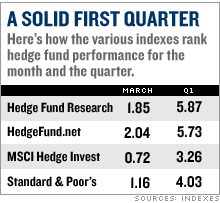
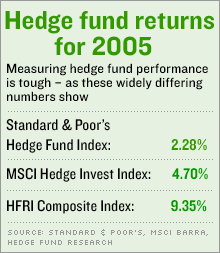
Hedge funds are private, lightly regulated investment pools for wealthy individuals or institutional investors. The funds use a wide variety of strategies, from betting on (or against) stocks, currencies or commodities to more esoteric strategies involving "derivative" investments or turning around distressed companies. But they generally won't welcome individuals as investors unless they have a net worth of at least $1 million. But more public and private pension funds are putting money into hedge funds to diversify their investments outside the stock market, meaning that many more average folks are getting exposed to these funds. Hedge funds are designed to deliver returns that are not correlated to the broader stock markets – when the markets are up, hedge funds may under perform, but they are expected to deliver returns even when the broader markets decline. Investors, undeterred by relatively low returns for hedge funds in 2005, pumped $8.1 billion in to stock funds, which take both long and short positions in the stock market. Equity hedge funds, with $359 billion in total assets, returned 6.46 percent in the quarter, according to HFR. Hedge funds as a whole returned 9.35 percent last year, according to HFR, though other indexes showed hedge fund returns in 2005 ranging from 2.28 percent to 4.7 percent. Measuring hedge fund performance is notoriously difficult, since hedge funds are private and are not required to report their returns to anyone but their investors. Hedge funds overall returned 5.85 percent in the first quarter, their best quarter since the second quarter of 2003, HFR found. Bond arbitrage funds gained a whopping $5.54 billion, nearly a 20 percent increase from the previous quarter, due to one start-up. Former Harvard endowment manager Jack Meyer's Convexity Capital launched in February with a reported $6 billion in assets, making it the largest-ever hedge fund launch. Meyer beat the market and quadrupled assets during his nearly 15-year tenure as manager of Harvard's endowment fund by shifting the fund into alternative assets, but he left the university over a dispute about how he and his team were compensated. (For more about the new manager of Harvard's $25.9 billion endowment, click here.) Event driven funds, whose managers seek to profit from betting on mergers, restructurings or other corporate events, gained $2.1 billion in new assets, for a total of $163 billion in assets. These funds got a boost from a big spike in merger activity during the quarter. Global macro funds, which invest in currencies and other instruments in foreign markets, saw the inflow of new money slow to a crawl, taking in just under $100 million in the quarter, down from a whopping $3.25 billion a year earlier. Short-biased funds saw their assets fall 1 percent, reflecting the difficulty of producing returns for these managers in a solid stock market. Short-biased funds manage about $3.2 billion in total, according to HFR. Funds of funds, which invest in pools of hedge funds, garnered $6.4 billion of new assets in the quarter, reversing a trend from the fourth quarter, when investors frustrated with low returns and high fees yanked some of their assets. While investing in a pre-packaged portfolio of hedge funds is less risky than investing in a single hedge fund, it's also more expensive. A typical fund of funds charges investors a management fee of 1 percent and a performance fee of 10 percent, on top of the hefty fees the underlying hedge funds charge. Funds of funds improved their performance in the first quarter, returning 4.73 percent. ------------------------ U.S. millionaire count hits record: More here.
Short seller Rocker to retire next year: Click here. |
|