|
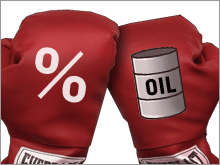
Oil, rising rates could spoil the party
Economists worry that crude at $70 a barrel and higher long-term interest rates could slow the economy; handicapping a recession.
NEW YORK (CNNMoney.com) - The United States rode out oil above $70 a barrel last fall but long-term interest rates were low. And consumers have grappled with mortgage rates at current levels but never when they were paying $3 or above for a gallon for gasoline.
Even without rates or energy prices at these levels, most economists were looking for slower economic growth in the second half of this year. But if $70 or $75 oil persists and rates keep rising much further, the one-two punch could take a bigger bite out of consumer spending than previously expected. Some economists even see the threat of a recession if recent increases continue. "It could be a very big hit," said Dean Baker, co-director of the Center for Economic and Policy Research. "I'd say there's a 10 to 15 percent chance of negative growth if we see a spike in interest rates, or a really big jump in energy prices." John Silvia, chief economist for Wachovia, said that while it's too soon to be cutting forecasts for economic growth later in the year, it's not hard to see growth 0.2 to 0.4 percentage points below current estimates if energy and interest rates stay at this level. And while that would seem like a modest adjustment, he said it would be an important change. "It is critical," he said. "Now you're talking about something where the economy is growing below trend. And that means that jobs growth will weaken, and that makes a difference in terms of people's perception of the economy." Baker, Silvia and other economists agree that rising energy prices act like a tax on the economy, slowing spending by both consumers and businesses, even if various economic readings show spending staying strong because the money is being spent on gasoline or diesel fuel. "Fundamentally, money you spend at the gas pump is money you don't have to spend at the mall," said David Wyss, chief economist for Standard & Poor's. And Wyss said that consumers are far more affected by the rise in the longer-term rates, measured by yields on the benchmark 10-year Treasury note and fixed-rate 30-year mortgages, than they are by the Federal Reserve raising short-term rates. "The economy responds much more to the long rates than to the short rates," he said. Strong enough to take the punches?
Still, Wyss and some other economists believe the economy is strong enough at the moment that even the combination of somewhat higher energy prices and somewhat higher rates won't be enough to cause a recession. Wyss said that even with the 10-year Treasury yield again near 5 percent and 30-year fixed-rate mortgages at about 6.5 percent, they are still cheap by historic standards. "It's still cheap to borrow money, just not as cheap as it used to be," said Wyss Anthony Chan, chief economist for JPMorgan Private Client Services, said that energy doesn't pack the economic wallop it did in the 1970s and 1980s, when the country was more dependent on manufacturing and less on technology and the service sector for its economic activity. "I don't have any doubt it's going to bite. The debate is whether it'll bite enough to cause a recession, and I don't think so," said Chan. "Because the economy remains fairly strong, it can withstand these one-two punches. If we were growing at 1 or 2 percent and we got this, the ref would tell everyone to go home." Chan and Silvia both say that if the 10-year note yield got up to 5.75 or 6.0 percent and oil crossed the $80 mark, they would be worried about a recession as soon as the end of this year, though Chan said he'd be less worried if the Fed responded quickly by cutting short-term rates in response. "They (Fed policy-makers) know at any point of the time they may need to administer CPR to this economy," said Chan. And Silvia said that even if oil only stays near $70, a recession could come if the 10-year yield were to jump near 7 percent. Gasoline soars amid shortages. Full story. For the look at the latest news on the oil crunch, click here. For a look at the latest news on bond rates, click here.
-- This is an updated version of a story that originally ran April 18. |
|