|
Vietnam sales: Hotter than China
Study rates Asian nation as world's third most-attractive marketplace -- overtaking China -- for retailers eyeing overseas expansion.
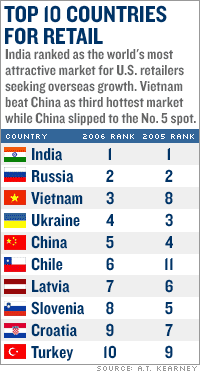
NEW YORK (CNNMoney.com) - In a classic David versus Goliath scenario, retail underdog Vietnam has overtaken the Asian behemoth China to become the world's third most-attractive marketplace for U.S. retailers looking to expand overseas, according to consulting firm A.T. Kearney. Vietnam jumped five slots to the No. 3 spot behind leaders India and Russia in A.T. Kearney's 2006 Global Retail Development Index (GRDI), an annual ranking of retail investment attractiveness among 30 emerging markets. China slipped 1 spot to land at No. 5 on the list.
Rounding out the top 10 international markets were Ukraine just ahead of China, and Chile, Latvia, Slovenia, Croatia and Turkey following at No. 6 through 10. Vietnam is the "little India" in terms of its retail potential for international companies looking to set up shop in the country, said Fadi Farra, principal with A.T. Kearney's consumer industry and retail practice and lead author of the study. "Vietnam today is similar to India five years ago," said Farra. "It combines strong economic growth with a highly fragmented retail market comprised largely of mom and pop shops." And also like India, Farra said Vietnam's biggest barriers to entry for international supermarket operators like the world's largest retailerWal-Mart (Research), Carrefour and Tesco are its foreign direct investment, or FDI, regulations, which prohibit non-Vietnamese companies from directly entering the local market, high import taxes and the difficulties in obtaining licenses to open more stores. China cooling off?
Setting aside those challenges, Vietnam offers a string of positive attributes that make it a more alluring option versus China for U.S. and other international companies, he said. According to Farra, China held the No. 1 spot in the index five years ago but has been slipping every since. "If I was a retailer looking for opportunity to grow abroad, beyond India, Vietnam is the place to invest in," Farra said. Why? Vietnam has one of the fastest growing economies in Asia. It's gross domestic product (GDP) -- a measure so the size of the economy -- grew a robust 8.4 percent last year, outpacing a much slower 3.5 percent annual GDP growth rate in the United States in 2005. Half of Vietnam's population of 84 million people are below the age of 30. This is significant, Farra said, because young people like to shop. To that point, consumer spending in Vietnam rose 16 percent last year and retail sales increased 20 percent in 2005 versus the previous year. China, by contrast, is showing signs of saturation fueled by the growth of international retailers like Wal-Mart, French supermarket chain Carrefour and British grocery store operator. A total of 40 global companies currently have stores in China, up from 8 in 2001. Consumer spending in China grew 14 percent last year while retail sales increased 12 percent. Between China, India and Vietnam, China is still the furthest ahead in terms of developing infrastructure to support retail expansion. Moreover, China has a per capita income of $5,600. That compares with India's per capital income of $3,100 and $2,700 in Vietnam. Said Farra, "China is still a very attractive market but the saturation levels are up to 65 percent particularly in the eastern cities like Shanghai. "The window of opportunity to enter a new overseas market is typically between five to 10 years," he said. "India is at the peak of that window right now. Vietnam is nearing that peak and China is cooling down." Some companies have found a way around Vietnam's regulationary hurdles are striking while the iron's hot. Farra said wholesale club operator Costco (Research), German supermarket operator Metro Group, South Korea's leading retailer Lotte and French retailer Bourbon have established a limited presence in the market through a joint-venture format with local business partners. "Retailers should look to at least set up a sourcing office in Vietnam so that they're in the country and studying the market," Farra suggested. "Vietnam certainly has a strong economy and a growing segment of the population that may like to shop at a Wal-Mart. We already source merchandise for Wal-Mart in Vietnam," said Wal-Mart spokesman Bill Wertz. However, he said Wal-Mart typically does not speculate on its international expansion plans. -------------------- Why there's no Wal-Mart in India. Click here for more. China: Your company name may not be yours. Click here for more.
Is "Made in U.S.A. back in vogue?" Click here to read more. |
|