Inflation fear: Pushing the button
A relic from yesteryear reminds us that inflation, while under control now, is still mysterious.
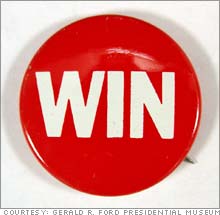
NEW YORK (CNNMoney.com) - Quick, can you identify the object pictured below to the right? If you are younger than 30, probably not. But c'mon you Baby Boomer types ... what is it?
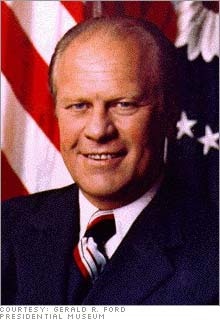
Time's up. It's a "WIN" button, part of the last-ditch program by Gerald Ford to stop runaway inflation in 1974. I remember seeing him on TV, holding up the button, and telling us it stood for "Whip Inflation Now." By wearing these buttons and banding together, we could defeat this scourge. "I say to you with all sincerity that our inflation, our public enemy number one, will, unless whipped, destroy our country, our homes, our liberties, our property, and finally our national pride, as surely as any well-armed wartime enemy," the President said at the time. And so "WIN" showed up on a lot of things ... socks, pens, ties, tee shirts ... even a gardening kit, complete with tools and seeds. "It showed up on a lot of odd stuff," said Don Holloway, curator of the Gerald R. Ford Library and Museum. "Some wanted to take advantage of the program to promote their mass-produced product. But others were intrigued by the program and wanted to show their support by putting WIN on different things." Now there was some economic theory, albeit tenuous, behind WIN. If you could get people to save more and spend less, then inflation might have less fire to feed on. But it has to be done on a large scale. And oil shocks tend to disrupt such a neat scenario. Besides, Americans aren't good savers to begin with. WIN was ridiculed. You can't boil economic theory and problems down to a feel-good talisman. Lucky for President Ford, but unlucky for the American people, unemployment became more of an economic crisis than inflation. And so WIN was pushed from the limelight. We don't need WIN buttons today. Inflation is still well under control. But the psychology of WIN, that fear of the unknown and somehow unfightable Boogey Man, is still there. Just witness the 200-point drop the other day. The consumer price report wasn't that bad ... only a tenth of a point above what was expected. There may have been some of the "Sell in May and Walk Away" credo in the sell-off. We are about to step into the historically slow summer months. So maybe inflation just provided the excuse. But if we eventually need some WIN stuff, Holloway says his museum has a bunch of it. _____________________________________
Allen Wastler is Managing Editor of CNNMoney.com and appears on CNN's "In the Money." He can be emailed at wastlerswanderings@cnn.com. |
| |||||||||||||