|
Another losing day for Wall St.
Dow closes below 11,000; blue-chip index, Nasdaq on four-session losing streak.
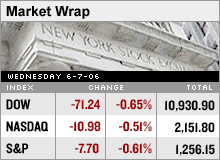
NEW YORK (CNNMoney.com) - The Dow Jones industrials fell for the fourth straight session Wednesday and closed below 11,000 for the first time in nearly three months as concerns about inflation and uncertainty about interest rates continued to hound investors. The Dow Jones industrial average (down 71.24 to 10,930.90, Charts) tumbled about 0.7 percent. The last time the blue-chip index finished below the key psychological 11,000 mark was March 9.
The 30-stock Dow, the world's most widely watched market gauge, has lost about 330 points over the past four sessions and has tumbled 6.1 percent since May 10, when it came about 80 points shy of its all-time high. The Standard & Poor's 500 index (down 7.70 to 1,256.15, Charts) declined 0.6 percent, and the Nasdaq composite (down 10.98 to 2,151.80, Charts) lost 0.5 percent. The tech-fueled Nasdaq has posted declines for four consecutive sessions, while the broader S&P 500 is on a three-session losing streak. A more than 2 percent decline in crude prices offered stocks some support Wednesday, but the relief rally fizzled in the afternoon as investors shifted gears and started selling. "We're really in a no man's land right now. We don't know if the market's been through a correction or if it's the start of a bear market," said David Briggs, head of equity trading at Federated Investors. No major economic reports were released, but investors took in more comments from Fed officials. Thursday brings another day light on economic reports, which lately in the market has resulted in choppy trading. As of 5:30 p.m. ET, Nasdaq and S&P futures pointed to a lower opening for stocks Thursday. Fed speak
Atlanta Fed President Jack Guynn said Wednesday that core inflation has exceeded the level he considers to be acceptable, joining the latest chorus of Fed officials to take a hawkish tone on inflation. (Full story.) Fed Governor Mark Olson also spoke, but didn't comment on the economic outlook. Former Fed chief Alan Greenspan testified before a Congressional hearing that the U.S. and world economy have been able to withstand the high price of oil, but some recent signs indicate that may be ending. (Full story.) While Greenspan no longer makes Fed policy, his words are still closely watched by policy-makers and investors, who are scrutinizing every comment from current Fed officials as they seek clues about the outlook for inflation and interest rates. Inflation worries, along with nervousness over interest rates, have roiled stocks all week. Chairman Ben Bernanke set off the latest round of jitters Monday, when he warned about inflation running uncomfortably high, as the economy starts to slow. (Full story.) The combination of rising inflation and slowing growth is especially lethal for stocks. "From our standpoint, (nervousness about inflation) is something that is keeping the Fed from backing off the brake pedal, and that's what's waylaying us," said Bryan Piskorowski, market analyst at Wachovia Securities. What moved?
Among Dow issues, 19 stocks advanced while 11 fell. Exxon Mobil (down $1.58 to $58.82, Research), down 2.6 percent, was the biggest decliner. Oil shares were weak. The Philadelphia Oil Service Sector (down $10.04 to $200.33, Research) index tumbled 4.8 percent after crude prices fell. U.S. light crude oil for July delivery sank $1.68 to settle at $70.82 a barrel on the New York Mercantile Exchange after the government's weekly inventory report showed a rise in crude and gas stocks. Chip stocks sank. Advanced Micro Devices (down $0.95 to $28.00, Research) posted a 3.3 percent decline, Intel (down $0.40 to $17.39, Research) slid 2.4 percent and Texas Instruments (down $0.71 to $30.72, Research) lost 2.3 percent. Elsewhere, shares of the NYSE Group (down $0.80 to $59.70, Research) fell about 1.3 percent after French president Jacques Chirac announced his opposition to the New York-based exchange's proposed merger with Europe-based Euronext. Shares of L-3 Communications (up $3.44 to $76.93, Research) surged 4.7 percent after the defense contractor's CEO died suddenly late Tuesday, leaving the company susceptible to corporate buyers. Target (up $1.30 to $48.90, Research) jumped 2.8 percent after Lazard Capital upgraded the retailer to "buy" from "hold." Pfizer (up $0.07 to $23.91, Research) rose after a news report said the drugmaker received bids of more than $14 billion for its consumer products division, which includes Listerine, Rolaids, Sudafed and other well known brands. Bidders include British drugmaker GlaxoSmithKline (up $0.51 to $56.00, Research), U.S. drug and consumer product maker Johnson & Johnson (up $0.23 to $61.17, Research), as well as a British household cleaning products maker, Reckitt Benckiser, according to a report in the New York Times. Market breadth was negative. On the New York Stock Exchange, decliners topped advancers by a margin of five to three on volume of 1.83 billion shares. On the Nasdaq, losers beat winners by a margin of four to three as 1.94 billion shares changed hands. Treasury prices fell, raising the yield on the benchmark 10-year note to 5.02 percent, up from 5 percent late Tuesday. Treasury prices and yields move in opposite directions. In currency trading, the dollar rose against the euro and the yen after hitting a one-month high versus the yen Tuesday. COMEX gold for August delivery fell for a second straight day, losing $2 to settle at $632.70 an ounce. ----------------- |
|