|
The war for start-ups going public
The London Stock Exchange's alternative market is gaining momentum against its larger rival, Nasdaq.
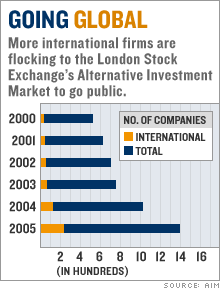
NEW YORK (CNNMoney.com) - Small companies going public are facing more and more obstacles in the United States, prompting venture capitalists to look to London. Some 40 U.S. firms have listed on the London Stock Exchange's Alternative Investment Market (AIM) since it launched more than a decade ago, and more companies from outside Britain are listing there every year.
The appetite for start-ups to sell shares to the public isn't what it used to be in the U.S., as investors are demanding more consistent profits and bigger deals. But instead of waiting to list on the Nasdaq, a growing number of venture capitalists say raising capital across the Atlantic is becoming the more desirable choice. "It's a viable option that is being considered more and more today and which probably wouldn't even have been considered a couple of years ago," said Maha Ibrahim, general partner at VC firm Canaan Partners. One of the biggest problems for small companies eyeing a public stock offering are strict corporate governance regulations that have disproportionately raised the costs of compliance for the little guy. "Companies are looking for markets that are more efficient, and for many of them, AIM is going to be a real alternative," said Keith Crandell, a managing director of ARCH Venture Partners and board member of the National Venture Capital Association. The London Stock Exchange launched AIM in 1995 in a bid to attract growth companies to the market. Since then, companies from around the world have flocked to list on the exchange, where most firms have a market value under $500 million. AIM attracted 519 companies last year, more than four times the 126 new listings on the Nasdaq. The next Nasdaq?
Many say there isn't much room left on the Nasdaq for smaller players. The AIM, on the other hand, is designed for smaller companies. "The Nasdaq has sort of grown up over the past few decades. Now you see Nasdaq dominated by big companies, which makes it tougher for new companies and new IPOs to get attention," said David Frankel, a managing director at VC firm Blueprint Ventures. For small and mid-cap firms, the costs, risks, and regulations associated with listing in the United States significantly outweigh the benefits, according to Anne Moulier, business development manager at the LSE. A listing on the AIM costs about $922,000, less than half the $2.3 million going public on Nasdaq would run a company, according to estimates from investment bank Cannacord Adams. And every stock on AIM has at least one analyst assigned to it, making it easier for small companies to attract the attention of bigger, more experienced institutional investors. Most companies go public on AIM through a so-called private placement, a process where a company's shares are offered to a select base of institutional investors that includes the likes of Fidelity, Goldman Sachs and Merrill Lynch. While the regulatory requirements on AIM may be less stringent, there's still tough competition for listings, which means companies have to bring strong business plans and management to the table, according to Francis Gaskins, president of IPODesktop.com. "Companies can get out on AIM at an earlier stage, and the amount of attention on AIM for a smaller company is much more preferable (than on Nasdaq)," said Andrew Gowans, a partner at Osborne Clarke, a European law firm that has helped Silicon Valley firms list on AIM. While AIM offers some significant advantages, it isn't an equivalent or more attractive alternative to the Nasdaq, Ibrahim from Canaan Partners said. "It doesn't have the prestige of Nasdaq because the liquidity and volume just isn't there yet," she said. But VCs said AIM is shaping up as a viable way for solid, small-scale start ups to raise cash, especially those with a European presence, and that's a welcome development. "I think it's always great to have options. We are seeing much more globalization of everything, including markets," Frankel said. "Now investors and companies can tap world markets fairly readily." -------------------- Related: Brazilian IPOs: Hot, hot, hot |
|