CNNMoney.com
Companies Economy International Corrections Pre-market trading After-hours trading Winners/losers/actives Bonds Currencies Commodities Money Magazine Retirement Mutual Funds Taxes Ask the Expert Money 101 Autos Loan Center Best Places to Live Calculators Mortgage Rates Personal tech Big Tech blog Techland blog Sectors and stocks Fortune 500 techs Tech Talk 100 best places to launch Ultimate resource guide Small biz makeovers FSB 100 Ask & Answer Fortune 500 Technology Investing Management Rankings Main Create portfolio Edit portfolio Create Alerts Edit Alerts
New rule: Hire passionate people.
Old rule: Rank your players; go with the A's.
By Betsy Morris, Fortune senior writer

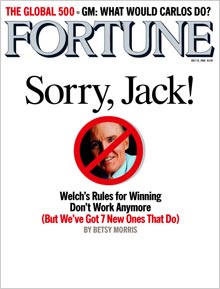
NEW YORK (Fortune) -- At GE under Welch, employees were ranked as A, B, or C players, and the bottom group was relentlessly culled.

"We're an A-plus company," Welch told his executives in 1997, according to Robert Slater's book, "Jack Welch and the GE Way." "We want only A players. Don't spend time trying to get C's to be B's. Move them out early."

fortune_welch.03.jpg
anne_mulcahy.gi.03.jpg

Pretty soon places as diverse as Charles Schwab and Ford (Charts) began ranking employees. But as with Six Sigma, the practice became overdone. Welch's "vitality curve," in the hands of less deft managers, became the "dead man's curve," or "rank and yank."

Everybody, it seemed, was expendable. There was a price to pay. According to a Rutgers and University of Connecticut poll in 2002, 58 percent of workers believed most top executives put their own self-interest ahead of the company's, while only 33 percent trusted that their bosses have the firm's best interests at heart.

"All of a sudden, when big companies had to change and respond to the marketplace and move quickly, they found out they couldn't, because they didn't have people engaged and aligned around the corporate mission," says Xerox (Charts) CEO Anne Mulcahy. "Then being big is a disadvantage. If you're not nimble, there's no advantage to size. It's like a rock."

While studying companies trying to transform themselves, Christopher Bartlett of Harvard Business School and a colleague found the major obstacle was inefficient use of increasingly disenfranchised employees.

"People don't come to work to be No. 1 or No. 2 or to get a 20 percent net return on assets," Bartlett says. "They want a sense of purpose. They come to work to get meaning from their lives."

Steve Jobs has emphasized that Apple (Charts) hires only people who are passionate about what they do (something that, to be fair, Welch also talked about). At Genentech (Charts), CEO Art Levinson says he actually screens out job applicants who ask too many questions about titles and options, because he wants only people who are driven to make drugs that help patients fight cancer.

GE (Charts) still ranks employees, but Immelt has also added a new system of rating - red, yellow, or green - on five leadership traits (including creativity and external focus). Employees are rated against themselves, not one another.

Immelt doesn't talk about jettisoning the bottom 10 percent. He talks about building a team.

"When you're 18 years old, you say, 'The iPod is neat,' " Immelt explains, "but people don't dream about making a gas turbine. If we can recruit the best 22-year-olds, we can double and triple in size. If not, then we're already way too big. You've got to be pragmatic about what turns people on."

Next:

6: Old rule: Hire a charismatic CEO New rule: Hire a courageous CEO.

________________________________________________

The new rules

Talk back in an online forum

REPORTER ASSOCIATE Patricia Neering Top of page

YOUR E-MAIL ALERTS
Follow the news that matters to you. Create your own alert to be notified on topics you're interested in.

Or, visit Popular Alerts for suggestions.
Manage alerts | What is this?
© 2008 Cable News Network. A Time Warner Company. All Rights Reserved. Terms under which this service is provided to you. Privacy Policy
Copyright © 2008 BigCharts.com Inc. All rights reserved. Please see our Terms of Use.
MarketWatch, the MarketWatch logo, and BigCharts are registered trademarks of MarketWatch, Inc.
Intraday data delayed 15 minutes for Nasdaq, and 20 minutes for other exchanges. All Times are ET.
Intraday data provided by Interactive Data Real-Time Services and subject to the Terms of Use.
Historical, current end-of-day data, and splits data provided by Interactive Data Pricing and Reference Data.
Fundamental data provided by Hemscott.
SEC Filings data provided by Edgar Online Inc..
Earnings data provided by FactSet CallStreet, LLC.