NFL sacks cable companies Move to put games on its in-house network puts the NFL at odds with cable operators, but could make the richest league even more valuable. NEW YORK (CNNMoney.com) -- This August is the most brutal month for the National Football League. While the games seem like they mean nothing, they will in fact determine who gets to be in the lineup when the season starts and who will be left out. Veterans face challenges from upstarts. And all of it is played out in unbearable heat.
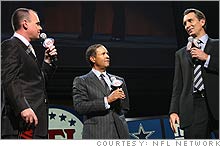
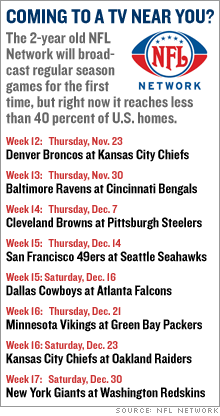
I'm not talking about the NFL training camps, which are inhuman enough. I'm referring to the clash between the NFL Network and the nation's leading cable operators. In January, the NFL decided that rather than pocket hundreds of millions more in rights fees for a package of eight late-season Thursday and Saturday games, it would give the games to its two-year old NFL Network. In the past, the league's own network has shown only pre-season and NFL Europe games live. "The NFL has all the cash it needs," said sports television consultant Neil Pilson, a former president of CBS Sports, of the NFL's decision to pass up offers from Comcast's (Charts) OLN Network and others to broadcast the games. He thinks it's a smarter long-term decision for the NFL to boost the attractiveness of its own network. The NFL Network won't get its first regular season game until Thanksgiving night, when it shows the Denver Broncos play the Kansas City Chiefs. Its broadcast team of Bryant Gumbel and Cris Collinsworth will call the game. The network will also show some second-tier college bowl games this year, along with 90-minute condensed versions of Sunday games throughout the week. But it's the live regular season games that are at the heart of the NFL's battle with cable operators. The decision to put regular season games on the network has already spurred some operators to offer it to more of their subscribers. That's increased the number of homes the NFL Network reaches from about 30 million in January to 41 million today. Top cable companies not yet on board But the nation's largest cable operators have yet to put the network on its basic lineup offered to all its customers. Some, such as Comcast and Cox, offer it only to digital customers. That cuts into the ad revenue the NFL can get for the games. The nation's No. 2 cable operator, Time Warner Cable, has thus far refused to carry the network at all, insisting that it only be included in a premium sports package of channels such as NBA TV and networks that carry college sports, soccer and racing. Not even all digital customers would get that package. (Time Warner Cable, like CNNMoney.com, is owned by Time Warner (Charts).) And when Time Warner Cable purchased 3.3 million cable households that were formerly owned by either Adelphia or Comcast last week, it tried to drop the network from the nearly one-third of those homes that had it. The NFL got the Federal Communications Commission to order Time Warner to keep the NFL Network on those systems, though. Now, Time Warner and the NFL are both trying to enlist members of the general public to support their cause. The NFL is advertising a phone number that directs fans to their local cable company's call centers so they can ask their provider to add the network to their system. Time Warner is asking its customers to sign an online petition to the league to let the cable company carry it as a package of sports networks. "We would like to carry the NFL Network and I assume they would like to be carried. It hinges on two factors -- the price and the placement," said Time Warner Cable spokesman Mark Harrad. Time Warner claims the NFL Network is trying to jack up the per-subscriber fee by 250 percent -- to the neighborhood of 70 cents to 90 cents a month per customer -- due to the addition of the eight games. "It's hard for us to understand how they can justify the price they want for an untested rookie," said Harrad. Seth Palansky, spokesman for the NFL Network, wouldn't comment on the issue other than to say, "We're comfortable our pricing makes the NFL Network one of the best values in the industry." Palansky said the network believes pressure from fans will be important in negotiations with the cable operators. But Harrad said the number of calls that Time Warner has gotten so far -- less than 8,000 from former Adelphia and Comcast customers who lost the channel, and only 88 cancellations, show the demand for the network is limited. Still, the NFL is actively courting cable competitors with its outreach program to fans. The network is already available in all 27 million satellite television homes covered by DirecTV (Charts) and EchoStar (Charts), and it also has deals to be carried on the new television offerings from phone companies Verizon (Charts) and AT&T (Charts). Sports TV consultant Pilson said the history of these types of battles between cable operators and regional sports networks shows that public and even political pressure generally causes the cable operators to give in, even if it increases their costs. And the NFL is more powerful than a regional sports network. "The NFL is the largest single entertainment property in the U.S. today, by a huge margin," Pilson said, adding that the NFL Network will probably be available in 50 million to 60 million homes within the next couple of years. "Most of the pressure will be on the cable operators," he said. "The force is with the NFL." Related: The NFL, post-Taglibue |
| ||||||||||||||