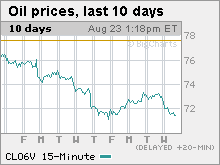
Oil tumbles on strong inventories Government reports a small drop in crude and a surprise build in gasoline supplies; oil falls below $72. NEW YORK (CNNMoney.com) -- Oil prices fell over $1 Wednesday after the government reported a high level of domestic petroleum supplies and tensions eased with Iran over its nuclear program. U.S. light crude for October delivery slid $1.20 to $71.90 a barrel on the New York Mercantile Exchange, having traded as low as $71.10. Oil was 55 cents lower just prior to the report's release.
In its weekly inventory report, the Energy Information Administration said crude stocks fell by 600,000 barrels last week. Analysts were looking for a drop of 1.2 million barrels, according to Reuters. Gasoline supplies posted a surprise gain of 400,000 barrels, while distillates, used to make heating oil and diesel fuel, swelled by 2.3 million barrels. Analysts were looking for a 1.9 million barrel drop in gasoline supplies and a 600,000 barrel build in distillates. "This week's numbers confirm we are already on a downward slope in terms of gasoline consumption," said Nauman Barakat, an energy trader at Macquarie Futures, the trading arm of Macquarie investment bank. "I think we'll test $70 again." EIA said stocks of crude, gasoline and distillates were all above average for this time of year. Analysts had factored in a loss of 200,000 barrels a day from the closure of 200,000 barrels a day from BP's giant Prudhoe Bay oil field in Alaska. BP had originally said 400,000 barrels a day, the entire field's capacity and 8 percent of the country's domestic production, would be shut in for months after severe corrosion was found along sections of pipeline. But the company later said half the field could remain open, easing jittery markets. The Iranian situation Also pushing prices down Wednesday was an apparent cooling of tensions between Iran and the West over the country's nuclear program. The Tehran government offered Monday to resume talks about its nuclear program but gave no public indication on whether it would agree to halt uranium enrichment and reprocessing. It was unclear if the gesture by Iran would avoid United Nations sanctions, threatened if the country doesn't halt uranium enrichment by Aug. 31. Western diplomats are still studying the proposal, but the the fact that it wasn't rejected outright has offered hope of a breakthrough. "Iran has thrown the ball back in our court," said Barakat. "It think it will be very difficult to put Iran in a box now." The threat of sanctions against OPEC-member Iran has rattled traders for months, as the country is the world's fifth largest oil producer and sits astride the narrow Strait of Hormuz, through which 25 percent of the world's oil passes. But the likelihood of sanctions actually passing the security council is far from certain, as veto-wielding China and Russia have been cool to the idea. Iran, BP only closing half its field and swelling inventories have helped oil prices ease 8 percent from last month, when crude hit a record trading high of $78.40. Also pushing down prices was the truce between Israel and Hezbollah, and creeping fears the world economy may be slowing. But keeping prices high - crude is still up 17 percent this year and isn't that far from its all time inflation-adjusted high of around $90 a barrel set in early 1980 -is a continued tight supply and demand situation and other geopolitical standoffs, including trouble in Nigeria. On Wednesday, the president of the Petroleum and Natural Gas Senior Staff Association of Nigeria said oil workers' unions might pull all members from the Niger Delta over safety fears following a spate of abductions by militants and a military crackdown, Reuters reported. Over half a million barrels of Nigeria's high quality crude remains shut in as militants from poor but oil producing sections of the country fight for a larger share of the nation's oil wealth. |
| |||||||||||||||||