|
Why small businesses shouldn't skimp on healthcare With some affordable options out there, there's no reason for small-business owners to not offer health coverage; here are some tips to get started. NEW YORK (CNNMoney.com) -- The good news is that the cost of employer-sponsored health plans has been declining in recent years. The bad news is that the number of small business owners that offer coverage has also fallen off. Last week, the Census Bureau reported that percentage of people covered by employment-based health insurance dipped slightly last year to 59.5 percent. In 1979, 69 percent of workers had health coverage from their employers.
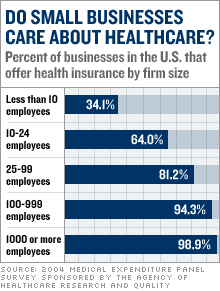
Small businesses are responsible. Almost all firms with more than one hundred employees offer health insurance; only 34 percent of firms with less than 10 employees have coverage (see chart). One big reason is that per-person premiums are much lower in large groups, according to Katherine Swartz, author of Reinsuring Health: Why More Middle Class People Are Uninsured and What Government Can Do. That's because insurance sold through bigger groups carries a lower risk for the insurer. In the case of small groups and individuals, insurers face a greater risk of high medical costs per person, according to Swartz. But despite the pressing needs of a small venture, industry experts believe there is no reason not to offer healthcare coverage. "Companies that offer insurance attract and are able to retain a more conscientious employee," said Grant Moore, director of Oregon-based Benefit Advisors, which provides employers with benefit packages for their employees. Not to mention, "taking care of your employees is just the right thing to do," he added. Unfortunately, many small business owners believe group health insurance is just too pricey, but they might be surprised to see what's available. Get covered without going broke While the options for employers are vast, mostly depending on the state and local carriers, there are affordable policies out there that all small-business owners should consider. Additionally, health plans are fully deductible as a business expense and any portion that the employer pays for his or her own coverage is tax deductible (that goes for employees too). For example, a Health Savings Account, or HSA plan, allows money to be put in before tax is paid on it and then withdrawn tax free for qualified medical expenses. Interest earned on the money is also tax-deferred. In order to open an HSA, you must have a qualified High Deductible Health Plan, or HDHP. Premiums for HDHPs are lower because the deductible is high ($1,050 for a single plan and $2,100 for a family plan as of this year). Also sometimes referred to as catastrophic medical plans, HDHPs mean that employees with a minor illness or injury will cover their medical expenses out of pocket, but they will be covered in the case of a serious illness. "This is the least expensive option for offering group insurance to your employees and it's a great place to start," Moore said. And, as the business grows, employers can choose to lower the deductible to $750 or $500. But this type of coverage is not ideal if an employee has high medical expenses or a lot of prescriptions. "The goal of the HSA is to allow people to roll over their money year after year," Moore said. Most people, though, according to Swartz, don't have major medical expenses. People with $50,000 or more in annual bills are in the top 1 percent, which accounts for 28 percent of total health spending. To get started, check out some sites like hsabank.com and nahu.org, which offer more information on coverage options and have lists of providers and health insurance agents. |
Sponsors
|