$79M tobacco award stumps Supreme CourtJustices split on issue of imposing large fines in product liability cases.WASHINGTON (CNN) -- A puzzled Supreme Court wrestled Tuesday over how to treat an Oregon jury's $79.5 million punitive damage award against tobacco giant Philip Morris USA, with company lawyers arguing the family of a longtime smoker deserves only compensation based on individual harm, not harm to the public at large. "Confine the jury to its proper domain, and its domain is the case before it," attorney Andrew Frey told the justices. "Other people can bring their own lawsuits."
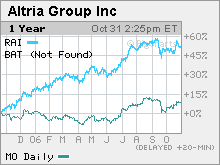
At issue is the discretionary power of juries to impose large damages against tobacco and other well-heeled corporations in product-liability cases. An Oregon jury ruled in favor of the estate of building custodian Jesse Williams, who had smoked cigarettes for 47 years - up to three-packs a day - and died of lung cancer in 1997. His widow, Mayola - who appeared at the high court with her family - sued Philip Morris, manufacturer of the popular Marlboro brand. The company is now part of the Altria Group (down $0.25 to $81.45, Charts). A majority of the justices appeared ready to throw the case back to state courts for a second time, without issuing a ruling on the merits. Several appeared torn over whether the Williams case followed recent high court precedent that punitive damages should in most cases be limited to "reasonable" harm suffered by the plaintiff, and that defendants cannot be punished for harm done to others, when only one person was suing. "Isn't perhaps the better course just to send this back to them [state courts] and say, we don't know what you mean?" asked Justice David Souter. A jury in 1999 found Williams and Philip Morris equally at fault for the smoking-related illnesses he suffered. It awarded $800,000 in compensatory damages, and almost 100 times that - $79.5 million - in punitive damages. Jurors concluded the company engaged in fraud and negligence affecting a large number of people over five decades. The trial judge reduced the punitive damages to $32 million, but higher state courts restored the award to the original amount. Much of the money, under state law, is to go to a special fund to help victims of crime. The punitive award has yet to be paid, pending outcome of the legal appeals. The high court had earlier sent the case back for review by the Oregon Supreme Court, which upheld its earlier judgment. It noted, "Philip Morris's conduct here was extraordinarily reprehensible, by any measure of which we are aware. It put a significant number of victims at profound risk for an extended period of time. The state of Oregon treats such conduct as grounds for a severe criminal sanction, but even that did not dissuade Philip Morris from pursuing its scheme." In Tuesday's oral arguments, Williams' attorney, Robert Peck, said the tobacco company "was engaged in a massive, market-driven fraud ... to deceive customers." And he said the jury properly took "the harm suffered by others into account in determining its disparity." That brought sharp reaction from several on the bench. "On the other hand, you cannot punish the defendant [Philip Morris] for those harms, particularly in a case where the defendant might have defense available with respect to those others" when deciding punitive damages, said Chief Justice John Roberts. "It's a fine line, but the reason it's a fine line is because of our prior cases, and it tried to draw the distinction between assessing responsibility and punishing for harm to others." "Punitive damages do not punish harm, they punish conduct," replied Peck. "The greater the wrong should receive greater punishment." Philip Morris, Reynolds American (down $0.54 to $62.96, Charts), and British America Tobacco (down $0.28 to $54.92, Charts) have been the subject of lengthy and high-profile class-action lawsuits - filed by individuals and the government - over their marketing strategy, and allegations they hid for decades studies showing the health risks of smoking. Consumer rights advocates argue such large punitive damages are necessary as a deterrent and retribution when corporate conduct is judged excessive or extreme. When company lawyer Frey argued for jury restraint, several justices expressed concern. "Isn't there a distinction between actual harm to others and the risk of harm?" asked Justice John Paul Stevens. "You're saying there was a general risk of harm to many, many people. ... We don't know whether they're harmed or not but that can be taken into account in fixing the ultimate verdict." In 2003, the high court ruled a $145 million punitive damages award against State Farm Insurance was excessive. The opinion stated, "Courts must ensure that the measure of punishment is both reasonable and proportionate to the amount of harm" someone suffers. The ruling set no precise ratio between punitive and actual damages for determining what would be "excessive" in violation of the Constitution's due process clause. But exceptions could be made, said the majority, "if a particularly egregious act has resulted in only a small amount of economic damages." Williams' attorneys argued that the Oregon jury believed that standard had been met in this case. Court records show Williams never believed claims that cigarettes were a health danger, until he contracted cancer. His wife testified Williams told her: "Those darn cigarette people finally did it. They were lying all the time." Outside the court, Mayola Williams, sitting in a wheelchair, said in brief remarks she was pursuing the case all the way to the Supreme Court, at her husband's dying wish. "I'm just praying for justice," she said. A ruling is expected within a few months. The case is Philip Morris USA v. Williams (05-1256). ---By CNN Supreme Court Producer Bill Mears --------------------------------------------------------------------------------------- |
|