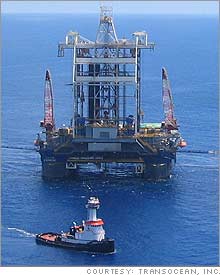
Big oil's expensive black gold questOne study says oil company spending is having little impact on boosting supplies, but firms continue to hunt.NEW YORK (CNNMoney.com) -- Soaring crude prices may have prompted oil companies to venture into ever hostile terrain to bring supplies to market, yet by one account all the spending may merely serve to hold production levels constant. According to a recent report from oil and gas consultancies John. S. Herold and Harrison Lovergrove & Co., investment in "upsteam" activities, which incude exploration and production, jumped 31 percent from 2004 to 2005.
Yet the study, based on data provided by publicly traded oil and gas companies worldwide, said production volumes grew just 1 percent, and proven reserves in the ground remained essentially unchanged. "The industry continued to labor to grow production and reserves," Arthur Smith, chairman of John S. Herold, said in the report. "The potential for stormy seas looms." Much of the increase can be blamed on a jump in the costs of steel and concrete - essential for making oil rigs, pipelines and ships - due to the worldwide commodities boom. Labor costs have also soared as companies race to ramp up production and take advantage of high oil prices. Moreover, not everyone agrees with John S. Herold's numbers. One analyst noted the long lead time it takes oil projects to go from conception stage to actually pumping oil, saying these boosts in investment would take several years to start bearing fruit. In fact, some argue that investing in exploration has paid off with new discoveries. "For all the people who claim that all the elephants have been found, you get another find like the one in the Gulf," said Damon Beyer, a partner at Katzenbach Partners, a Houston-based management consulting company with expertise in the energy industry, referring to Chevron's recent announcement that they had successfully drilled in their massive Jack # 2 oil field. But bringing these new discoveries to market is not cheap. It's estimated the Jack # 2 field will only be economical if oil stays above $50 a barrel. Big oil continues spending on exploration & production In their latest quarterly filings, most oil majors reported substantial increases in their capital expenditure budgets, which include costs for exploration and production. Exxon (Charts), with third quarter revenues of $99.6 billion, spent $5.1 billion on capital investments in the quarter, a 16 percent increase from the year prior. Chevron (Charts), with revenues of $54.2 billion, boosted spending a whooping 42 percent to $4.1 billion, mostly due to tapping reserves it acquired when it bought Unocal, one analyst said. Capital budgets were up at ConocoPhillips (Charts) and BP (Charts) as well. For their investment, the majors reported a fairly decent rise in production, which they credited to their long-term investment budgets. Exxon reported a 7 percent rise in production in the quarter, while Chevron said it boosted output 6 percent. Analysts say big oil companies aren't being cavalier with most of their projects, making investments based on a long-term price projection for oil to eventually trade in the $30s. So that means even the recent slide in oil prices - crude has fallen over 20 percent since highs reached in July - won't have much of an impact on long-term capital budgets. "You don't turn off a capital budget with every up tic and down tic in price," said Mark Gilman, an oil and gas analyst with The Benchmark Co. "The economics are not based on the price today, but on the price three, four, five years down the road." _____________ |
|