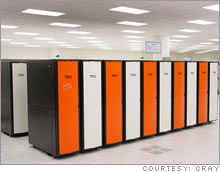
Supercomputers to the rescueDesigners aim to make the world's most powerful computers more user-friendly.NEW YORK (CNNMoney.com) -- Supercomputers don't come draped in a cape or tights, but they're heroic nonetheless. These powerful machines tackle some of the world's most critical problems - from forecasting how global warming will affect the climate to monitoring the country's nuclear stockpile.
Supercomputing received a big boost last week, when a Department of Defense agency said it would spend nearly $500 million for Cray (Charts) and IBM (Charts) to develop the next generation of supercomputers. Under the program led by the Defense Advanced Research Projects Agency (DARPA), the designers of the next supercomputers are charged with making the machines more usable and productive - which could have a big impact on how the smart machines are used in the future. "This procurement isn't just about building a bigger machine. It's also about building software tools to create a machine that is easy to use," said Jan Silverman, senior vice president of corporate strategy at Cray. Cray is working on building what it calls "adaptive supercomputers" - machines that can figure out on their own which processors are the best match for each application, and thereby optimize performance. Supercomputing technology has historically been difficult to use since programming these machines requires a depth of knowledge, said Dave Turek, IBM's vice president of deep computing. The DARPA funds are expected to help change that by helping IBM accelerate its development of technologies that make systems easier to use and more productive, he said. Prototypes are due to be delivered to DARPA by 2010, but new products based on the research conducted for the program are likely to make it to the marketplace before then, Silverman said. What does the push to make supercomputers more user-friendly mean? Already, most people feel the impact of supercomputers in their everyday life without realizing it. Automakers, for instance, can use computers to simulate more extensive crash test results for their vehicles. But more easily programmable machines could result in a wide range of industries harnessing greater computing power to find better solutions faster, Turek said. If scientists can predict how a virus will evolve, they can develop and stock vaccines ahead of time. If bankers can run more portfolio scenarios, they can tap more financial opportunities. If an oil company can analyze data faster, it can better focus exploration efforts. "There are problems on the sidelines waiting for these sophisticated tools - and they exist in every industry you can think of," Turek said. |
Sponsors
|