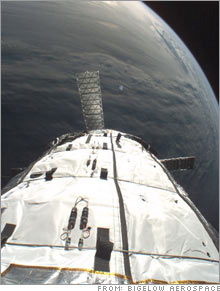
Vacations in outer spaceHas the holiday chaos got you thinking about the perfect winter getaway? Before long the trip of your dreams might just be thousands of miles above you. (Business 2.0 Magazine) -- Ah, the holidays. There's nothing like scuffling at 6 a.m. with bleary-eyed shoppers over the last Nintendo Wii, or watching the kids wail as they sit on Santa's lap, or spending some "quality" time with the in-laws for even the most spirited of souls to start dreaming of another place - preferably one that's far, far, far away. Like outer-space faraway.
Well cheer up, yuletide wipeouts. The day is fast-approaching when we can all spend a little post-holiday R&R in a hotel that's, literally, out of this world. Seriously. With almost no fanfare, the wealthy owner of a Las Vegas-based hotel chain is fast expanding his business into space. He's already launching experimental inflatable hotel modules - and making money out of the deal without even booking his first zero-G guest. Who's this modern-day Willy Wonka? Bob Bigelow, the 60-year-old owner of the Budget Suites of America hotel chain and a reclusive innovator who exhibits almost a childish glee. He can afford to: Budget Suites pays the bills and then some, enabling Bigelow to spend $500 million on a pet project called Bigelow Aerospace. The venture's slogan is "Getting you excited again about space." An $8 million escape to space Believe me, there's more than a whiff of 1969-style enthusiasm here. This summer, a Russian rocket launched carrying an inflatable space habitat. Called Genesis-1, it's essentially a retooled NASA design for which Bigelow acquired the patents in 2001. Bigelow then spent $75 million and years cutting through red tape before getting the greenlight to launch objects into orbit via Russia. Bigelow's primary goal for the Genesis-1 launch was to prove that inflatable space hotels were not just a drug-induced dream of the 1960s. It worked: The module inflated with oxygen provided by a life-support tank at its center. The resulting "room" was four to ten feet in diameter. Cramped? Yes. But livable. The walls are made of a textile called Vectran, a Kevlar-like material that helps make it resistant to collisions with space debris. It has a very cozy internal temperature of 26 degrees Celsius, and is currently orbiting above us at an altitude of 356 miles and a speed of 3 miles a second. Long term, Bigelow's goal is to franchise his space hotels. The company has already built a model of a second inflatable habitat, called the Nautilus, that's more than 10 times the size of Genesis-1, or about the size of a three-bedroom house. The company plans to sell its Nautilus modules, which will be fully fitted with oxygen support and sweeping views of the Earth zooming by at 17,000 miles an hour, to franchisees for $170 million each (launch costs included). But as more modules are built and sold, the price will likely plummet. Bigelow Aerospace is also building a third craft called the Sundancer. Set for launch in 2009 or 2010, the Sundancer will be the biggest orbiting hotel by far, with about 6,400 cubic feet of habitable space. It will also be the first "human-rated" module, meaning it will ready for you to move in at any moment. So how much will a space cruise cost the Average Joe? One week on the Sundancer alone will cost $7.9 million per person, predicts Bigelow. While pricey, it's a steal compared to the $20 million that Space Adventures, another orbital flight company, charges for a week-long whirl on the International Space Station. Taking the space bus Bigelow Aerospace, meanwhile, is growing by leaps and bounds. Genesis-1 turned out to be a prototype for another type of business. An internal camera broadcast to Mother Earth images of objects placed inside before launch, including a Spongebob Squarepants toy. (That's right: Spongebob made it to space before you did.) With photos in hand, Bigelow Aerospace started a "Fly Your Stuff" program whereby space buffs will send, for as little as $295, prized possessions aboard the next module, the Genesis II, that's set to launch in January. But if you're thinking of packing up the Big Bertha that drove your hole-in-one last year, think again. The program's sold-out. But you can still play space bingo, which is another webcam-based experiment that Bigelow hopes to pull off aboard Genesis II. The new game will feature floating bingo balls that occasionally trigger a webcam snapshot of a single ball. People on Earth play via the Internet. Meanwhile, Bigelow is looking at additional ways to bring space flight to the masses. In September, his company announced a deal with Lockheed Martin (Charts) that will ultimately allow it to ferry passengers to space hotels. At the time, Bigelow is encouraging entrepreneurs to devise transit systems that would bring tourists to his inflatable getaways. He's pledged $50 million to anyone who can demonstrate by 2010 a private orbital shuttle service that works. There are doubts about Bigelow's timeline. Only a handful of companies are gunning for the $50 million "America's Space Prize," including PayPal founder Elon Musk's SpaceX. But SpaceX hasn't had a successful launch yet, and no private vehicle has reached Earth's orbit. There is hardly the level of excitement that surrounded an earlier $10 million giveaway for a suborbital craft that Burt Rutan's SpaceShipOne landed in 2004. Maybe if Bigelow were to extend his deadline by a few years he'd get what he's looking for: A space plane that zips vacationers from the coast to the cosmos. Necessity, after all, is the mother of invention. And as the 2006 year-end festivities peak, you'll no doubt agree that the more holidays we spend pining for space from our relatives, the more attractive - and imperative - a true space escape becomes. _______________________ More from Future Boy: Tech politics: friends on Capitol Hill BMW steps on (the hydrogen) gas To send a letter to the editor about this story, click here. |
|