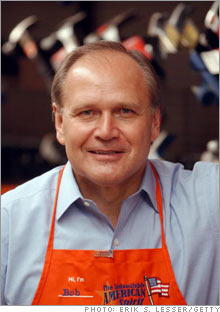
Nardelli's downfall: It's all about the stockThe Home Depot CEO improved the retailer's numbers, but the market didn't believe he could deliver the future. Fortune looks behind a shocking departure. NEW YORK (Fortune) -- Robert Nardelli's sudden exit as Home Depot's CEO is the biggest shocker since Carly Fiorina got booted out of Hewlett-Packard (Charts) in 2005. At companies this huge - both have revenues of about $90 billion and are in the top 20 of the Fortune 500 - they like everything smooth and predictable, and hate sharp disruptions. So while there's a lot we don't yet know about this story, we know that something big and bad was going on. And we know a couple of other things as well: The problem, as usual, was the performance of Home Depot (Charts) shares. "The stock is in the tank," complains Bernie Marcus, who co-founded the company and led it until Nardelli came in as CEO in December of 2000. Much has been written about Nardelli's mammoth pay, but as Marcus says, "if the stock had doubled, who would have cared?" Instead it went nowhere, and that's what this is all about.
Nardelli was well trained in finance during his long career at General Electric (Charts), and he understood what typically makes a stock go up. He increased Home Depot's return on capital impressively, to almost 20 percent. That's ten full percentage points above the firm's cost of capital, which is a very good spread and something investors love to see. But investors - particularly retailing investors - need more. They also need to believe that the company can maintain or increase that spread for many years into the future - that other companies won't swoop in and compete it away. And investors need to believe that the company can invest increasing sums of capital on which it will earn that spread. The market clearly didn't believe either of those things. It believed instead that competitors, mainly Lowe's (Charts), would keep growing and would prevent Home Depot from increasing its spread. And it believed that the company would be unable to grow its invested capital; indeed, under Nardelli Home Depot returned billions in capital to investors through stock buybacks, in effect telling shareholders, "Here, you invest this money. Maybe you've got better ideas for it than we do." Even though the stock is right where it was when Nardelli got the job six years ago, the company's market value has actually fallen by 40 percent, calculates analyst Peter Cohan, because those stock buybacks have reduced the number of shares. Bottom line, even though Nardelli increased revenues and profits enormously, investors didn't believe he could invest increasing amounts at an attractive return in the future - and the future is what investors buy. The other thing we know is that there's big-time boardroom intrigue behind this move; we just don't know what it is yet. The key player would appear to be lead director Ken Langone, though he goes unmentioned in any of the official company statements. He was also a director of GE, Nardelli's previous employer, and engineered Nardelli's move to Home Depot. All evidence suggests he was the main force behind Nardelli's knockout pay. And we know that Langone is a man of the fiercest loyalty, Exhibit A being his defense of former New York Stock Exchange chief Dick Grasso (Langone was also on the NYSE's board). So Nardelli's abrupt departure suggests that Langone has had a massive change of heart about Nardelli. (When Fortune called Langone's office for comment, we were referred to Home Depot, which so far has not responded.) For his part, Marcus believes that the board responded to "an accumulation of things," including two Nardelli missteps: "the quality of the service in the stores, and the last shareholders meeting was a fiasco," says Marcus, referring to Home Depot's 2006 annual meeting, which took less than an hour and included none of the directors except Nardelli. One thing we don't know is the kind of CEO that Nardelli's replacement, Frank Blake, will be. That's because Blake, a Harvard-educated lawyer who once served as deputy secretary for the U.S. Department of Energy, has been a behind-the-scenes strategy and corporate operations guy ever since Nardelli recruited him to Home Depot from GE in 2002. Marcus says that Blake - not an interim CEO but the real designee - "is more people-oriented" than Nardelli. "He'll relate very well with the people in the stores, with the merchants, and with the financial institutions." That's an endorsement, but investors should beware. Just as Nardelli lacked something critical - retail experience and the proper people skills - when he took charge as CEO six years ago, Blake has a clear deficit as well: He has never run a P&L business. Just as Nardelli did, Blake has something big to prove. Fortune editor at large Patricia Sellers contributed to this story. |
|