Marilyn Cazayoux: Playing catch-upThis divorced mother of two got a late start in crafting her retirement plan. But there's hope yet. NEW YORK (Money Magazine) -- For her retirement, Marilyn Cazayoux doesn't need anything more elaborate than her home in the small city of Lafayette, La., the company of friends and nights zydeco dancing. Oh, and self-sufficiency: "I don't want to rely on help from my children," she says.
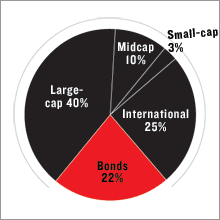
But despite fastidious saving habits, the 57-year-old mother of two isn't sure whether she can realize her vision by her hoped-for retirement date in 10 years. After all, Cazayoux began saving only nine years ago, after divorce sent the former homemaker into the work force full time for the first time in decades. Where she is now In those nine years, Cazayoux has saved an impressive $145,000. But she'll receive no pension from the oil and gas pipeline supply company where she works as an account manager, and her only other source of retirement income will be an estimated $14,000 from Social Security. She squirrels 15 percent of her $53,000 pay into her 401(k) and puts an extra $75 a month toward the principal of the mortgage on the $175,000 home she bought last year, in hopes of paying it off in full before she retires. Her careful budgeting often leaves her with as much as $250 left over at the end of the month to add to her savings. But while she's aggressive at day-today savings, she's way too conservative an investor. Concerned about the possibility of a bear market, she's put a third of her money in bonds and nearly half in large-cap U.S. stocks. "I understand if there's not a big gain, but I don't think I can afford to lose," she says. The high investment expenses on her portfolio don't help either. Some of the eight funds in her $40,000 401(k) have annual fees of as much as 2 percent. That plus her too-cautious investing approach hurts Cazayoux's chances of accumulating enough money to retire securely in 10 years, says Robert Reed, a financial planner in Covington, La. What she should do To start, says Reed, Cazayoux should put the full amount in her IRA each year (in 2007, $5,000 for those 55 and older) instead of paying off the mortgage. She can think of the mortgage as a low-cost way of borrowing money in order to build up her savings faster. She should likewise view any raises as a chance to add to the savings in her 401(k) and brokerage accounts. Unfortunately, the high fees in Cazayoux's 401(k) will continue to drag down her returns. So Reed suggests that she concentrate her 401(k) in just two of the least expensive funds in the plan. She'll want to ditch the expensive funds in her brokerage accounts as well and replace them with low-cost Money 70 choices such as Muhlenkamp and Harbor Bond. Investors Cazayoux's age typically should have about 40 percent of their savings in bonds. But given that she plans to work for 10 more years and needs to make up ground, Reed suggests she take more risks. First, she should move her entire IRA into T. Rowe Price Retirement 2025 (TRRHX (Charts), a target-date fund with 80 percent of its holdings in stocks today. Because that fund is designed for someone who plans to retire in nearly 20 years, not 10, that's more stocks than she might normally own. But this one fund, Reed points out, spreads her money among a more diverse set of funds than she could otherwise buy with the $32,000 in her IRA. Another way to temper this aggressive stance is by diversifying smartly, including keeping 25 percent of her money in foreign funds to capture market gains abroad. If she makes these changes and continues to save as much as she can, Cazayoux could retire in 10 years with a $600,000 portfolio. That could sustain annual withdrawals of about $24,000, bringing her total income to $38,000, almost 70 percent of today's salary. Cazayoux is eager to give it a try. "As long as I'm healthy, I want to be out doing something," she says. The Money 70: Best funds you can own More Makeovers: Richard Rivera and Cynthia Centeno Brian and Kim O'Donnell: Starting out in hock |
| ||||||||