The O'Donnells: Starting out in hockFirst get organized. Then, get aggressive about investing. This portfolio will help anyone with decades to go benefit from stocks' long-term potential. NEW YORK (Money Magazine) -- Like so many romances today, Kim and Brian O'Donnell's story began with a visit to an online dating Web site. Even though Kim lived 400 miles away and in another state, Brian e-mailed her after he noticed that her profile mentioned a love for the outdoors. Kim suggested they meet for some biking and night kayaking.
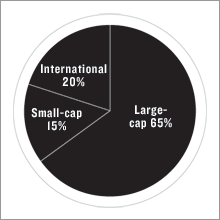
That was the summer of '05. Exactly one year after meeting, the 34- year-olds relocated to a new home in North Carolina and married shortly thereafter. "It all happened really quickly," says Kim. "Suddenly there's all these things we hadn't thought about, like investments and insurance." And a mortgage. And a credit-card balance. And all those persistent student loans. Where they are now Brian, a pediatrician who went to medical school while in the Air Force, earns about $105,000 a year. He expects his clinic to offer him a partnership in 2009, which will likely bump up his salary but require an outlay of about $130,000. Kim, a former pricing analyst for a freight company, isn't working now and hopes to start a family soon. The newlyweds' debt has ballooned with their new $307,000 mortgage, along with $27,000 in car and student loans. They also just added $3,000 in credit-card debt, which they admit will likely increase as they begin furnishing their new house. On the other side of the ledger, Kim has almost $60,000 in a jumble of five retirement accounts and an annuity. She also owns a rental property in Fort Lauderdale valued at $250,000. Brian has $95,000 in his Thrift Savings Plan, the government's version of a 401(k), and another $36,600 in IRAs, most of it in high-fee mutual funds. Financial planner Karen Keatley of Charlotte, N.C. found that 36 percent of Brian's income goes toward payments on their loans. "This couple has too much debt and too little cash," she says. What they should do Given the O'Donnells' need for quick cash, Keatley thinks Kim should consider working for now. Another fast way to get on track: sell Kim's condo. Although the property would likely appreciate over time, the couple's need to free up cash is more pressing. They'd walk away with about $100,000, enough for them to retire their auto, student-loan and creditcard debt, saving them $11,000 a year in debt payments. It would also allow them to establish a much needed $35,000 emergency fund, make $8,000 in Roth IRA contributions this year and begin saving for Brian's partnership. Next, Keatley recommends that the couple ditch their high-fee funds and consolidate their IRA plans with a single provider. Two of Kim's five accounts are 401(k)s from previous employers. She should roll both into a traditional IRA, which would give her more investment choices and less paperwork to keep track of. Kim also pays 1.5 percent in annual fees for an annuity she purchased in 1995 for $1,450, which is now worth just $1,600. That's a pathetic 10 percent gain over a decade. Keatley notes that the broker who sold that annuity could easily have made more on commissions than Kim did on the investment. Since Kim won't owe a surrender charge if she sells, she should bail out now. Finally, noting their youth and willingness to take risks, Keatley suggests Brian and Kim keep 100 percent of their portfolio in stock funds and names three index choices: Vanguard 500 Index (VFINX (Charts), Vanguard Small-Cap Index (NAESX (Charts) and Vanguard Total International Stock Index (VGTSX (Charts). The two should each max out Roth IRAs until Brian has enough tenure to start contributing to his 401(k). At that point the couple should start saving 15 percent of their income each year for retirement ("at least," says Keatley). And, furniture or no furniture, they should not take on any additional debt except to finance Brian's stake in the partnership. The O'Donnells agree. "We took on a lot all at once and over-leveraged ourselves," says Brian. "Now it is time to start climbing out." The Money 70: Best funds you can own More Makeovers: Richard Rivera and Cynthia Centeno Marilyn Cazayoux: Playing catch-up |
| ||||||||