DETROIT (CNNMoney.com) -- General Motors unveiled a plug-in hybrid vehicle that, the company says, offers a preview of a high-mileage vehicle platform that GM could use in future vehicles.
The Chevrolet Volt, which is driven by electricity alone, uses a small three-cylinder gasoline engine only to recharge its batteries. The batteries can also be charged by plugging into an ordinary electrical outlet.
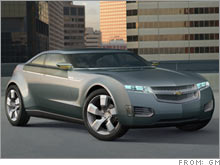 |
| Chevrolet Volt concept car |
Gallery: Chevrolet Volt
Starting with a full charge, the car could theoretically operate for about 40 miles at suburban street speeds without needing to burn any gasoline at all.
It would take about 6.5 hours to fully charge the Volt's batteries from an outlet. The vehicle could, however, be driven without a full charge but would need to rely on its gasoline engine sooner.
Unlike other hybrid cars, such as the Toyota Prius, the Volt's gasoline engine would never power the car's wheels. Instead, it would recharge the car's batteries if needed while the car would continue to run on electric power alone.
The Volt's electric motor can produce up to 121 kilowatts, the equivalent of about 161 horsepower. It can produce 320 newton-meters, or about 236 foot-pounds, of torque. Electric motors offer more torque - the pulling power a car uses to accelerate - relative to their kilowatt or horsepower output than gasoline engines do.
Building an affordable plug-in hybrid will require advances in battery technology, the company said. Batteries powerful enough to allow the kind of highway speed drivers are accustomed to also tend to produce a lot of excess heat. Battery companies are researching ways to produce batteries that last longer and don't run as hot, while still being able to store and release ample power.
Hybrid history
Until recently, only Toyota, Honda and Ford sold gas/electric hybrid vehicles in the U.S.
General Motors Saturn Vue Green Line SUV, has a "mild hybrid" system. That means the Vue cannot drive, even at low speeds, on electric power alone. The advantage of the system, according to GM, is its lower cost compared to more robust hybrid systems.
GM will begin selling vehicles with a more advanced "two-mode" hybrid system later this year. That system will be available initially in the company's large SUVs. It is housed entirely within the vehicle's transmission tunnel and is engineered to provide optimal performance in both low-speed, stop-and-go and highway driving. Most hybrid systems provide the greatest benefit in stop-and-go driving but are not help much in high-speed cruising.
Electric cars
At the Los Angeles Auto Show in November, General Motors outlined a strategy to prepare for the future "electrification" of the car.
GM's reputation had suffered because of the company's reliance on large SUVs for profitability. A recent documentary film, "Who Killed the Electric Car?" focused on GM's role in ending California's experiment in the 1990s with promoting all-electric cars.
GM and other companies, including Toyota, produced electric cars that were sold in California at that time. All those companies dropped plans to make and market the vehicles once California changed rules requiring them.
Plug-in hybrids are seen as a more viable alternative to all-electric vehicles because they do not need to stop and recharge when their batteries run out. They can still run on purely electric power at relatively low speeds and for relatively short distances. Charging a battery takes hours, not a the few minutes it takes to fill a car with gasoline.
Supplementary power for a vehicle like the Volt could come from gasoline, "renewable" fuels like ethanol or biodiesel, or compressed natural gas. It could also be provided by a hydrogen fuel cell, which creates electricity in a chemical process that produces water.
Gallery: Chevrolet Volt 


