
Problem no. 2: Oil dependencyWestport Innovations has the inside track to convert millions of diesel engines to run on cleaner natural gas. SAN FRANCISCO (Business 2.0 Magazine) -- The background: In addition to national-security issues, there's another pressing reason to wean ourselves off oil: Transportation is second only to electricity generation as a contributor to global warming, accounting for roughly a fifth of carbon emissions. And transport-generated emissions rank as the fastest-growing source of greenhouse gases in China, India, and other developing countries. While manufacturers have dramatically cut exhaust emissions from standard cars, they're only starting to do so for 18-wheelers and other commercial vehicles powered by diesel engines. More than a quarter-billion diesels are in operation today, and manufacturers will turn out another 31 million new ones this year. 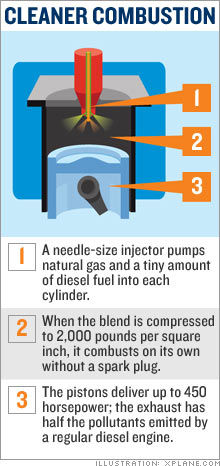 The solution: Westport Innovations has spent a decade developing a conversion technology, called high-pressure direct injection, that allows diesel engines to run on cleaner-burning liquid natural gas. Westport claims that its HPDI system slashes a diesel's greenhouse emissions by a fourth - the equivalent of about 500 million tons per year if all were converted. Last year the EPA certified HPDI for commercial use, and the ports of Los Angeles and Long Beach - America's largest shipping hub - announced one of the biggest emission-reduction programs ever, promising to nearly halve greenhouse output within five years, even as shipping volume is expected to quadruple. The payoff: Starting this year, operators of 5,000 diesel trucks that haul cargo to and from the port terminals must convert to natural gas, and Westport, based in British Columbia, has the first-mover advantage. "The only viable product is Westport's," says Henry Hogo of the South Coast Air Quality Management District. At almost $80,000 per truck, Westport CEO David Demers says, the deal will help double his company's revenue starting this year. While most of Westport's $43.6 million in sales has come from a related product - spark-ignited natural-gas engines for buses - it's allowed Demers to keep refining HPDI. "We couldn't go for the holy grail right away," he says. "We had to find an intermediate product to build critical mass." The opportunity: Global diesel engine sales will hit $160 billion this year. As the market grows, so does demand for clean engines, until hydrogen and fuel-cell technologies are ready for prime time. Washington-based Energy Conversions is selling natural-gas retrofits for locomotive engines and power generators used in offshore drilling. And major diesel manufacturers are inventing new filters to meet tough new standards. Other companies, like California-based Clean Energy, are ramping up the infrastructure for LNG filling stations. "In 10 years, Ford and Volvo think they can run direct-injection engines with hydrogen fuel," Demers says. "But we're not going to see mass adoption of hydrogen until we first have mass adoption of natural gas." |
Sponsors
| ||||||||||


