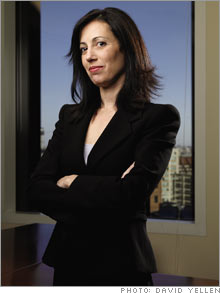
A tech veteran's prophecies for the industryFormer software engineer Nina Hughes is posting great numbers at RiverSource Global Technology. Here are the stocks she likes now, says Fortune's Katie Benner. (Fortune Magazine) -- When River Source hired Nina Hughes to run its Global Technology fund, the company got more than just a great stock picker and technology analyst. Hughes has been a hedge fund manager, an electrical engineer who helped develop the government's first GPS system, a genetics researcher and a biomedical software engineer. Her hands-on knowledge of the sector helped her post a 20 percent gain in 2006; she's earned an annualized 14.7 percent (through Dec. 31) since taking over in June 2002, putting Global Technology (Charts) in the top 10 percent of international tech funds. She spoke to Fortune's Katie Benner about what's ahead for tech in 2007, and what stocks she's looking at now.
Why are investors piling into technology stocks now? The tech sector has really had a hangover since the bubble. It has taken us almost ten years to soak up excess fiber build-out, and companies have not spent on technology since everyone upgraded in 1999. Now the infrastructure we have is stretched. So for corporate America to see productivity levels increase, it will have to spend on technology. That's making the sector very attractive. A lot of funds are still underweight in tech, and valuations are very good for private equity takeouts. These are great growth drivers too. Does that mean we're headed for another bubble? It's a different era for technology. There hasn't been the overspending that we saw in the first boom, or the excess build-out. Tech firms are much more worried about their balance sheets now, so development and capacity are more controlled. You mentioned private equity - do you expect to see more buyouts in the sector? Yes. A lot of small or lesser-known tech companies are finally seeing valuations that are attractive to private-equity firms. They look at cash flow yields - the free cash flow per share divided by the share price. If a company has a 10 percent free cash flow yield, for example, a private-equity firm can essentially buy it for free as long as it can get a loan with an interest rate of 10 percent or less. So private-equity firms are circling around these companies and have taken some out, like Freescale Semiconductor. It seems like you've done it all - engineering, software development, genetics research and business. You've even worked in the hedge fund and mutual fund worlds. How has this helped your investors? I only look at the tech industry because that's where I have expertise. And while most people go from the mutual fund to the hedge fund side, I wanted to learn and understand a different investment style. I also thought there was something else I could bring to the table. When I talked to a lot of mutual fund managers they were very worried about relative value, which never made sense to me because you're trying to make money for your investors. I worked at a hedge fund, so I didn't want to just compare my returns to an index; I wanted to establish a fund on an absolute basis that would make money for investors. What stocks do you like now? I'm looking at Infineon (Charts), a cheap and under-the-radar semiconductor company with an attractive valuation vs. competitors like Freescale and NXP. The company is restructuring and has had significant design wins in the wireless segment. We'll see increasing revenue growth and increasing margins in the coming years. Another example is Atmel (Charts), a $3-billion-market-cap semiconductor company that has a 10 to 13 percent free cash flow yield. The company has a new CEO, Stephen Laub, and is changing its business model. Traditionally 95 percent of its development and production was internal. Now it's moving to a fab-light model, meaning that it doesn't do its own fabrication but uses foundries instead. That will improve its gross margins and significantly improve cash flow. In software, I like Nuance Communications (Charts), a speech recognition company. Its software is used by call centers and airlines. High-end autos and health-care providers are starting to use it as well. Nuance also has some new sales management that's been a great help. I think that Seagate (Charts) should produce double-digit unit growth in 2007 because of a favorable PC environment and continued proliferation of HDDs (hard disk drives) into consumer electronic devices like DVRs, video game consoles and GPS navigation systems. The company should also benefit from its Maxtor acquisition. And I like Rackable Systems (Charts). It targets server and storage spending in large data centers, and its target customer is looking for highly scalable, cost effective solutions - think eCommerce. Its products are built using industry-standard components and therefore carry a lower cost of ownership; and Rackable emphasizes greater power efficiency across its product set, which saves customers money. To some extent, technology and money management are still male-dominated worlds. Does this affect you on the job? I am aware that there can be a double standard, still, for women. Once when I was out marketing some of the funds, someone told me that he liked my numbers, but wanted to know who took care of my family. I was flabbergasted. Every man you've ever thought of letting manage your money is probably also responsible for a family as well. To ask me that question implies that the men aren't ever responsible for their families, and that's not right. But no one in this industry or at my job has ever questioned my abilities just because I have a family. I have a 2-year-old and a 3-and-a-half-year-old, and they give me energy. I come home from a long day and they spark me up. To have balance, you need to know what's important to you. I have to have a company that supports me. Some firms might not understand that you can still work well without physically being in the office 12 hours a day. I also have a great nanny and my husband is amazing, and when I'm home that time is about my family, not about going to the gym or being out with friends, and that's fine. My husband reminds me that I need to do things for myself, but I'd rather spend time with them. _________ |
Sponsors
|