
Bulls set for a challengeJust how resilient is the recent rally? Investors will find out in the week ahead, when a rash of reports showing weaker growth is expected.NEW YORK (CNNMoney.com) -- Weaker growth is the trend that will tie most of next week's big economic reports together. But for a stubbornly bullish stock market, the bad news may not be so bad. That's because a recent stream of economic reports - and comments from Federal Reserve Chairman Ben Bernanke last week - suggest that growth is slowing enough to take the edge off inflation, but not so much so as to send the economy into a recession. It's the well-known "goldilocks" scenario - and one the stock market likes.  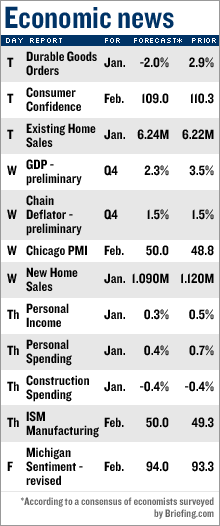 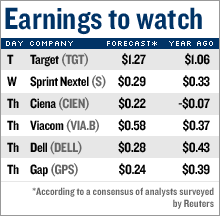 
If this scenario does play out, the argument goes, the central bank should be able to continue holding interest rates steady, as it has done since August. Stock market participants would generally prefer lower rates - lower borrowing costs make it cheaper to do business, which boosts corporate profits and stocks. However, they'd rather see no change than more hikes. So a little bit of weaker economic news next week would be unlikely to disrupt the rally. Unless the news is a lot weaker than forecast, in which case worries about a recession could return, giving investors a reason to back out after an 8 month stock market rally. In a busy week, the big standouts are: fourth-quarter GDP growth, expected to be revised downward considerably from the initial reading; personal income and spending, as well as the report's corresponding inflation reading; and the week's many housing and construction related reports. (See chart for details). "As housing goes, so likely goes the Fed," said Timothy Ghriskey, chief investment officer at Solaris Asset Management. "If we see housing prices start to stabilize around current levels, the Fed will stay on the sidelines," he said. "If housing pricing either rebounds or retreats dramatically, the Fed will have to act." The key period to watch won't be until next month when the residential selling season begins, Ghriskey said, but next week's numbers will nonetheless be in focus, particularly amid amped up worries about subprime mortgage lenders. Dell (Charts), Target (Charts) and Viacom (Charts) dominate a skimpy week for corporate earnings. (See chart for details.) Oil and Iran, vs. M&A Beyond the economic news, investors will be keeping an eye on crude oil prices, which hit a 2007 high on Friday after a drop in U.S. weekly inventories and new worries about Iran's nuclear capabilities. That also sent a variety of commodity prices higher, with gold prices hitting a 7-month high. The run up in prices gave a lift to metals and mining stocks, as well as to energy stocks, but also put a damper on any broader market advance. Last week, the Dow hit a record close and the S&P 500 and Nasdaq composite hit more than six-year highs, before all 3 retreated at the end of the week. The selloff revived concerns that a long-called for broader selloff could be on tap, particularly after 8 months of gains. "At some point we'll see a pullback where the buyers don't come right back in, and that could lead to a decline for a few weeks," said David Briggs, head of equity trading at Federated Investors. However, he said that any such selloff would likely just serve to "reinvigorate the bulls' juices." That's partly because any such selloff would be countered by the continued impact of strong merger activity and speculation, all of which has been fueling stock gains lately, said Paul Mendelsohn, president and chief investment strategist at Windham Financial Services. Most signs point to a continuation of the merger activity, particularly with private equity firms showing such an appetite for purchasing right now, he said. All of which gives the stock market a firm footing, Mendelsohn said. "As long as the merger activity keeps happening, sector rotation keeps happening and the sellers remain on the outside, it's going to be very interesting." Iran: Unstable, troubled oil giant |
|


