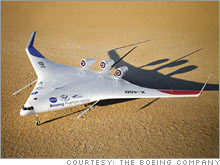
Radical new Boeing aircraft takes flightThe company's new blended-wing plane prepares for its first test, carrying with it the airline's hopes for fuel-saving planes. (Business 2.0) -- -- It would be a dream come true for the airline industry: A plane that uses up to 30 percent less gas to reach its destination, compared with today's jets. That's the promise of the blended-wing, a radically new kind of aircraft set to take to the skies for the first time this month. Originally conceived by McDonnell Douglas and developed by NASA, the blended-wing merges fuselage and wings and eliminates the tail, reducing drag. That makes it vastly more fuel-efficient than regular "tube-and-wing" jets, according to Boeing (Charts) engineer Norm Princen.
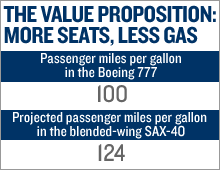 His X-48B blended-wing prototype, now on the runway at Edwards Air Force Base, is only about a 10th the size of the 240-foot-wingspan craft he hopes to build. But the Pentagon is watching keenly. "Blended-wing technology can cost-effectively fill many roles required by the Air Force," says Capt. Scott Van-Hoogen of the Air Vehicles Directorate. As a tanker, for example, it could refuel two planes in midair at the same time. For now Boeing is focused on making a military version of the plane by 2022. But by 2030 blended-wing aircraft could be carrying commercial passengers. Last November a team from MIT and Cambridge University unveiled the SAX-40, a blended-wing design that promises to be more fuel-efficient than a Toyota (Charts) Prius - and thanks in part to the engine placement, just as quiet (at 63 decibels). These designs still have a bumpy ride before they'll be accepted by airlines: How to build a flat pressurized cargo hold is one challenge; another is asking passengers to sit 25 seats away from the window. Still, the rising costs of air travel may leave future road warriors with no choice but to blend into a blended-wing. To send a letter to the editor about this story, click here. |
Sponsors
|