
Caterpillar jumps on the green bandwagonThe industrial giant finds that sustainability plays in Peoria, says Fortune's Marc Gunther. NEW YORK (Fortune) -- Will it play in Peoria? Since the days of vaudeville, entertainers, politicians and business people have come to this mid-sized midwestern city, halfway between Chicago and St. Louis, to take the pulse of middle America. 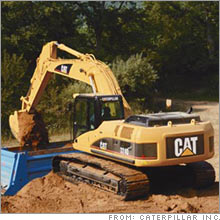 Towering over the city is Caterpillar, Peoria's biggest employer. An 82-year-old industrial giant with $41.5 billion in 2006 revenues and 95,000 workers, Caterpillar makes "big iron" - mining, construction and road-building equipment, diesel and marine engines, and gas turbines, among other big-ticket items. This is not, in other words, a company where you will find a bunch of tree-huggers. Even so, here are the headlines that jump out when you open Caterpillar's just-off-the-press 2006 Sustainability Report: Rapid population growth. Limited natural resources. Strained ecosystems. No simple solutions. Yes - Caterpillar (Charts, Fortune 500) is getting real about sustainability. While no one would confuse this conservative icon of smokestack America with, say, Ben & Jerry's, the changes unfolding here are further signs that the greening of corporate America is unstoppable, and that products and services that help solve big environmental problems can be good for business. As Jim Owens, Caterpillar's chairman and CEO, puts it in his introduction to the report: "Sustainable development can create value for our customers, investors and environment." What Caterpillar means by sustainable development is nothing less than "meeting the needs of the present without compromising the ability of future generations to meet their needs." That's a radical goal, when you think about it - it calls into question the operations of some of Caterpillar's biggest customers, including companies that mine coal, copper and iron ore (all of which are in limited supply) or those that extract oil from the sands of western Canada, where hundreds of Cat machines are at work. The biggest and best example of sustainability inside Caterpillar is a unit called Cat Reman. That's the business that sells remanufactured equipment and components that the company says will meet its performance standards, but at prices substantially below those of new products. Cat Reman itself isn't new - it's been around since the 1970s - but lately it has grown briskly. Revenues are up by 67 percent between 2001 and 2006, in part because of acquisitions, and the unit now employs about 2,000 people at 15 facilities around the world. Besides remaking Caterpillar equipment and parts, Cat Reman does remanufacturing for Ford (Charts, Fortune 500), General Motors (Charts, Fortune 500) and Daimler Chrysler (Charts), among others. "Reman is really a recycling business," explains Steve Fisher, a Cat vice president who oversees the unit. "Instead of wood, paper and plastic, we're recycling engines and components." The environmental benefits are significant - recycling industrial equipment saves raw materials and energy and reduces waste. What's more, if the U.S. takes steps to require manufacturers to take back their products, as the European Union has done, Caterpillar will be ready. Meanwhile, Cat is supporting efforts to build mass transit systems to reduce pollution and congestion in 18 big cities in Asia and Latin America. Close to home, Cat makes diesel/hybrid engines for low-pollution General Motors buses in Seattle. The company has also been a leader on environmental policy. Cat was one of the original members of the U.S. Climate Action Partnership (USCAP), a group of 10 companies and four big environmental groups that have called on the federal government to enact strong legislation to regulate greenhouse gases. That can't have been easy for a company that sells more mining equipment than any other - and whose biggest customers include coal companies that oppose carbon regulation. Cat's Fisher told me that company executives had to persuade their coal company customers that carbon regulation would not prevent the development of "clean coal" power plants. Meanwhile, Caterpillar has established targets for its own operations, aiming to reduce greenhouse gas emissions, waste, water use and workplace injuries. It has sought advice from environmental groups like Environmental Defense. Indeed, Caterpillar's journey to sustainable development got a big push back in 2005 when CEO Owens invited Jonathan Lash, the president of the World Resources Institute, a Washington-based think tank, to spent a day with senior execs in Peoria talking about sustainability. Still another push came from Fred Mason, a plain-spoken Caterpillar executive with 34 years of tenure, who got the company involved with an organization called the World Business Council on Sustainable Development. "I'm the curmudgeon for sustainability," Mason told me. (Disclosure: I volunteered to moderate a sustainability summit this week in Peoria, organized by Cat.) None of the changes at Cat are groundbreaking. General Electric (Charts, Fortune 500) has gone further by setting revenue targets for products and services that improve the environment. Cat remains wedded to selling big iron. And there's not even a mention in the sustainability report of a controversy set off by the death of Rachel Corrie, a 23-year-old American peace activist who in 2003 was run over in the Gaza strip by a Caterpillar bulldozer, operated by Israeli Defense Forces. That has sparked a lawsuit and protests against Caterpillar. In response, Caterpillar has said that it can't control how its products, once they are sold, are used or misused. That may be. But if the company is to become a force for sustainable development, it will have to take a more expansive view of its responsibility. Ultimately, Cat will want to engage more closely with dealers and customers to ensure that its products are used to good ends. |
Sponsors
|


