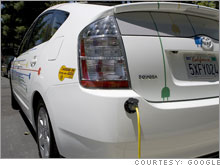
Google pushes 100-mpg carOffers millions to advance plug-in hybrid vehicles and other technologies that link nation's transport system to the electric grid.NEW YORK (CNNMoney.com) -- Google said Tuesday it is getting in on the development of electric vehicles, awarding $1 million in grants and inviting applicants to bid for another $10 million in funding to develop plug-in hybrid electric vehicles capable of getting 70 to 100 miles per gallon. The project, called the RechargeIT initiative and run from Google's philanthropic arm, Google.org, aims to further the development of plug-in hybrid electric vehicles - cars or trucks that have both a gasoline engine and advanced batteries that recharge by plugging into the nation's electric grid.
"Since most Americans drive less than 35 miles per day, you easily could drive mostly on electricity with the gas tank as a safety net," Dan Reicher, director of Climate and Energy Initiatives for Google.org, wrote on the organization's Web site. "In preliminary results from our test fleet, on average the plug-in hybrid gas mileage was 30-plus mpg higher than that of the regular hybrids." The project also aims to develop vehicle-to-grid (V2G) technology, allowing cars to sell their stored power back to the nation's electricity grid during times of peak demand. "Linking the U.S. transportation system to the electricity grid maximizes the efficiency of our energy system," said Reicher. "Our goal is to demonstrate the plug-in hybrid and V2G technology, get people excited about having their own plug-in hybrid, and encourage car companies to start building them soon." General Motors (Charts, Fortune 500) has promised to sell a plug-in hybrid version of its redesigned Saturn Vue SUV but has not set a specific date for production. The company has contracted with two battery suppliers to work on an improved battery technology for the vehicle. The company is also working toward a production version of its Chevrolet Volt, a plug-in hybrid concept car shown at the 2007 Detroit Auto Show. That vehicle would be driven entirely by electricity with an on-board engine used only as a back-up generator. Ford Motor Co. (Charts, Fortune 500) also has a drivable plug-in hybrid demonstration vehicle based on the Ford Edge SUV. Similar to GM's Chevrolet Volt in its basic engineering, that vehicle uses a hydrogen fuel cell as a back-up generator but could use a gasoline engine or some other type of motor to charge the batteries. Because they have to store up and release large amounts of electricity, plug-in hybrids require more advanced batteries than hybrid vehicles currently on the market. The batteries in non-plug-in hybrid vehicles continuously store and release small amounts of electricity, a work cycle that puts little strain on the batteries.
Google takes on Detroit
While many people don't associate Google with energy, analysts say the fit isn't all that unnatural. Renewable energy, unlike coal or nuclear, will likely come from thousands or tens of thousands of different locations. Analysts have long said that one of the big challenges will be managing that flow into and out of the nation's electric grid, and that companies that manage the flow of information are well placed to handle that task. The $1 million in Google grants went to Brookings Institution to run a conference on plug-ins, CalCars and Plug-In America to educate the public about plug-ins, and the Electrical Power Research Institute, the Rocky Mountain Institute and Dr. Willett Kempton from the University of Delaware for plug-in R&D. Google (Charts, Fortune 500) also said it has turned on its massive solar panel installation at the company's Mountain View, Calif. headquarters. At 1.6 megawatts, Google said it's the biggest solar project on a corporate campus in the United States, and one of the largest in the world. |
Sponsors
|