
Why I cut down my supersize gym chain
By paring down my gyms, I'm better able to please customers, boost profits, and get my life back.



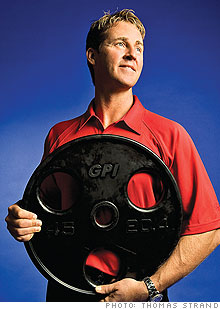

CHANHASSEN, MINN. (FORTUNE Small Business -- For most of my career in the fitness industry, I ran "big box" gyms - giant facilities with amenities that ranged from child care to aerobics classes to walls for climbing - in my home state of Minnesota. These clubs tried to cram as many offerings into their spaces as possible, and at first I didn't question that philosophy.
I started operating my first gym when I was 21. While I was playing pro racquetball in Florida, the owners of a troubled large fitness center in Willmar, Minn., asked me to come back and turn the business around. Over the next five years I worked like crazy: I opened and closed the club myself, ran the front desk, and even painted the walls. Eventually I made the club profitable and bought out the owners. Later I leveraged the building to open five more gyms, all of them successful - and huge.
Running these big boxes took its toll. The gyms had huge overhead. It cost more than $1.5 million to buy the buildings, requiring me to take out significant loans. I also had to supervise about 200 employees and drive to each location daily to meet with managers, tour facilities, and monitor programs such as tiny-tot swim lessons. By the time I opened my fifth new gym in 2002, I saw my kids only twice a day - when they woke up and when they went to bed. That year I decided to sell the gyms.
Six months after I cashed out, a group of my former employees approached me about starting a new company. I missed the business but knew I had to do things differently - I was finished with 75-hour workweeks, and I didn't want to make a massive investment. I thought about my old business model: It required large memberships to generate cash flow for operations; it was hard to launch each gym; and many gym features sat idle, such as swimming pools and steam rooms.
I grabbed a pen and paper and listed all of the old gyms' amenities on the left side of the page. Reading my notes, I saw that my clients didn't need - or want - most of those features; many of them used to ask me if they could pay less and use only the basic equipment. I chose the essentials and wrote them on the right side of the page. That list became the blueprint for a smaller, more efficient gym - Snap Fitness.
My old fitness centers were 40,000 square feet; a Snap Fitness gym is less than 3,000. The buildings, which I lease instead of own, cost $150,000 to open - the big gyms had cost 12 times as much. Because of the low overhead, it takes fewer members to break even (and they pay, at most, $35 a month at Snap Fitness, compared with $50 to $80 monthly dues at the big box gyms). Operating the centers is a breeze: They require low maintenance, little insurance, and only ten days to open once the landlord hands me the key. It takes just one person to run the entire gym. Now I'm out the door by 6 P.M.
Initially other owners told me I was crazy to cut features like group fitness classes. But I soon disproved the naysayers. After opening my first Snap Fitness in 2004, I built 18 more by the end of the year. Today the chain has 160,000 members and 1,173 franchises in 45 states, and projects 2007 revenues of $16 million. Our success is a product of today's busy culture. Baby-boomers like me - those of us with full-time jobs who enjoy spending time with our families - want to be able to walk in, work out, and leave. It's a better, leaner business model, and it makes my life easier too.
- As told to Mina Kimes 
A road map for aspiring franchisers
Is my business franchise-worthy?
What are the steps to buying a franchise?

-
 The Cheesecake Factory created smaller portions to survive the downturn. Play
 -
 A breeder of award-winning marijuana seeds is following the money and heading to the U.S. More
 -
 Most small businesses die within five years, but Amish businesses have a survival rate north of 90%. More
 -
 The 10 most popular franchise brands over the past decade -- and their failure rates. More
 -
 These firms are the last left in America making iconic products now in their twilight. More









 My dream is to launch my own business someday. Now that it's time to choose a major, I'm debating if I should major in entrepreneurial studies or major in engineering to acquire a set of skills first. Is majoring in entrepreneurship a good choice? More

 When it comes to in-flight pampering, the amenity kits offered by these 10 airlines are the ultimate in luxury More
 From a text therapy platform to apps that push you reminders to breathe, these self-care startups offer help on a daily basis or in times of need. More
 From Uber's flying cars to the Hyperloop, these are some of the neatest transportation concepts in the works today. More
 More Small Business


