
Flight delays cost $41B in 2007 - study
A congressional committee says flight delays cost $12 billion to passengers, $19 billion to the air industry and $10 billion to other industries.



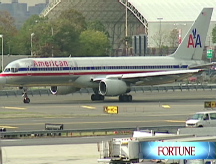


NEW YORK (CNNMoney.com) -- Domestic flight delays cost the industry and passengers $40.7 billion in 2007, according to the Joint Economic Committee from the House and Senate, which released a report Thursday.
As part of this overall cost from the delays, passengers lost an estimated $12 billion worth of time that would otherwise have been spent on business and play, said the committee report.
These late flights cost airlines $19.1 billion in extra staffing, fuel and maintenance costs - mainly from planes idling at the gate but also from taxiing delays and from circling airports in holding patterns, according to the report.
The cost to airlines includes $1.6 billion in fuel costs, as idling planes wasted 740 million gallons of jet fuel, the report said, releasing more than seven million metric tons of carbon dioxide into the air. This was based on the 2007 average wholesale fuel cost of $2.15 per gallon.
The committee also said that delays caused $9.6 billion in "spillover costs" to other industries that rely on air traffic, like restaurants, hotels, retailers and public transportation.
The calculations from the Air Transport Association, a trade group that represents the airline industry, are significantly different. ATA spokesman David Castelveter said that delays cost the industry $8.1 billion last year, which is less than half of the $19 billion estimate from the Joint Economic Committee. Castelveter said the industry cost is expected to rise to $10 billion this year. He said that he doesn't exactly know how the committee arrived at its calculation, so he doesn't know why the number is different.
The committee study, based on an analysis of 10 million domestic flights, said more than 20% of all flight time last year was wasted on delays. It said most delays were caused by other flights arriving late.
While some delays are "unavoidable" because of weather and mechanical problems, "the staggering levels of delays experienced in 2007 and the significant costs these delays had on the U.S. economy are troublesome," read a statement from the bipartisan committee, chaired by Sen. Charles Schumer, D-NY.
The report is the latest bit of bad news for a battered industry, whose top players include Delta Air Lines (DAL, Fortune 500), United Airlines (UAL) and American Airlines (AMR, Fortune 500). Carriers have have been raising ticket prices and attaching fees to basic services to try and minimize losses, and Delta and Northwest Airlines (NWA, Fortune 500) are working on a potential $3.1 billion merger.
Some of the nation's busiest airports caused the biggest drag on air travel, said the committee, with Atlanta Hartsfield-Jackson International accounting for nearly 19 million delayed passenger hours, with nearly 18 million hours for Chicago O'Hare International and more than 12 million hours for Dallas-Fort Worth International.
From a passenger perspective, the worst offender was the comparatively tiny New Castle County Airport in Delaware, which averaged 55 minutes of delay per passenger in 2007, compared to 16 minutes per passenger at the Atlanta airport. By this measure, the best airport was Honolulu International, with an average of five minutes delay for passenger.
The committee said traffic will only get more crowded, putting further strains on the industry. The report said that flight volume is up 43% since 1998, and is projected to keep increasing 2.7% annually, from 689 million passengers currently, to more than 1.1 billion in 2025.
The report blamed "seven long years of laissez-faire government policies," including a failure to convert the nationwide radar system for aviation tracking to a system based on satellites. The committee said that congestion could be alleviated by opening military air space off the eastern seaboard for commercial traffic.
"Opening up a portion of this underutilized space would allow commercial airlines to avoid congested areas over New York City, Washington, Atlanta and Florida or bypass bad weather when it arises on the east coast, thus significantly reducing delays," said the report.
But if anyone's to blame for delays, it's Congress, according to Michael Derchin, an airline industry analyst for FTN Midwest Securities Corp.
"They've not funded the [Federal Aviation Administration] and the air traffic control system, which is using 1960s technology," he said. "The fix is to get the air traffic control system fixed. It's now at a point where it's a crisis, and now Congress is blaming everyone else, and they're the ones who started it to begin with."
Castelveter, the ATA spokesman, said the Department of Defense agreed to open some military airspace to relieve congestion in the New York and New Jersey region for the Memorial Day weekend. But for the long term, he said the government must update the air traffic control system from radar to satellite to cut down on delays.
"It's the equivalent of using an electric typewriter, when others are using computers, Treos and Blackberries," he said. 



