
Why the Fed has to ignore inflation
The central bank has been justifiably on inflation watch lately. But fears about a Fannie and Freddie meltdown may force the Fed to hold back on rate hikes.




NEW YORK (CNNMoney.com) -- Inflation risks haven't gone away, but the Federal Reserve might not be able to do much about it right now.
Inflation hawks had been hoping the Fed would finally start to attack rising prices by raising interest rates. But the near-meltdown of Fannie Mae and Freddie Mac could tie the Fed's hands, forcing the central bank to keep rates low.
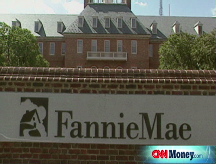
Fannie (FNM, Fortune 500) and Freddie (FRE, Fortune 500), the two government-sponsored mortgage financing giants, play a critical role in making home buying affordable for Americans since they buy pools of mortgages from lenders.
Shares of both firms plunged last week, with much of the losses coming in a frantic day of trading Friday, as investors feared that a government bailout would be needed to save them.
The Fed and Treasury Department proposed a rescue plan on Sunday. The Treasury Department is aiming to increase the line of credit that Fannie and Freddie have with the Treasury as well as give Treasury the option to buy shares in the two firms.
And the Fed has opened up its so-called discount window to Fannie and Freddie, which allows the firms to borrow directly from the Fed.
But if Fannie and Freddie require an even bigger rescue, this could make it much more expensive for people looking to buy a house. So one way the Fed could do its part to minimize the pain created by a bailout of Fannie and Freddie would be to keep its benchmark federal funds rate steady at 2% for a while.
"The cost of a mortgage to those buying a home will be higher than it would have been. This, along with other factors, can be managed by the Fed holding its interest rate low for longer than it might have," said James Glassman, senior economist with JPMorgan Chase.
In addition, the collapse of IndyMac (IMB), the second-largest bank failure in history, may keep the Fed from raising rates for fear that higher interest rates could spur even more bank shutdowns.
With that in mind, some economists think that the Fed's next move could even be to lower rates again in order to make sure the credit crisis doesn't worsen.
"The problems in the credit markets and continued tightening in loan standards will dampen economic activity further," said Kenneth Kim, economist with Stone & McCarthy Research Associates." "The Fed could lower rates in the fourth quarter once the stimulus from the tax rebate checks wear off."
If the Fed does that, that could put further pressure on the dollar. A weak dollar, especially against the euro, has been cited by many economists and market experts as a big reason behind the surge in the price of crude and other commodities, such as corn and soybeans.
I've been arguing for some time that the Fed has to be more worried about the threat of inflation than the housing mess and credit crunch. I even thought the Fed would raise rates before year's end.
But the Fannie/Freddie/Indy mess may justifiably put the Fed back in crisis-management mode.
We'll probably get a better sense of the Fed's thinking tomorrow when Fed chair Ben Bernanke makes his semi-annual appearance before the Senate Banking Committee.
It's likely that Bernanke will address the mortgage problems in his prepared remarks and will be grilled by senators in the question and answer session for more details about what the Fed plans to do regarding Fannie and Freddie as well as inflation and the dollar.
But Bernanke may have to essentially backtrack from what the Fed said in its last statement in June when it held rates at 2%.
At the time, the Fed said that "although downside risks to growth remain, they appear to have diminished somewhat, and the upside risks to inflation and inflation expectations have increased."
While the latter part of that statement is still true, the first part no longer seems accurate. So Bernanke needs to be careful. While he has to acknowledge that rising commodity prices remain a threat, he no longer has the luxury of ignoring the obvious.
"Bernanke has to say that there are some concerns about inflation but he has to reiterate that there are concerns about growth and he has to emphasize how balanced these risks are," said Chris Probyn, chief economist with State Street Global Advisors. "He needs to stop saying that the downside risks are gone. It would be appropriate to say that they are still there."
In other words, he needs to send the strong message that no rate hikes are in the cards just yet - even though rising oil prices are still a problem.
"The Fed will have to prioritize and the first priority should be to calm the markets. Bernanke has to reassure the market that it is not eager to pull the trigger on interest rates," Probyn said.
Issue #1 - America's Money: All this week at noon ET, CNN explains how the weakening economy affects you. Full coverage.
Gas prices have climbed to record levels. Are you feeling the pinch? Tell us how gas prices are affecting you and what you're doing to cope. Send us your photos and videos, or email us and tell us what you think. 



