
Why oil won't fall below $100
With a surge in the price of global commodities, it's costing more to produce a barrel of oil than ever before.



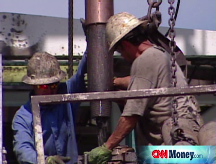



NEW YORK (CNNMoney.com) -- Last week, falling oil prices looked unstoppable. The last few days have seen a halt in that slide. Still with prices well below the record set in July and a shaky world economy threatening demand, the question remains: How low can oil go?
Many analysts say oil is unlikely to go much lower than $100 a barrel, and it has to do with the rising cost of production.
The overall cost to produce oil has gone up, especially oil from tough to reach places like Canada's tar sands and the deep water Gulf of Mexico.
These areas require massive investment and materials to produce oil and that expense has risen as the price of commodities surge. And while they represent a small fraction of total worldwide production, they're important because some analysts believe prices won't fall below the cost of the most expensive barrel of oil.
"I don't think it will go down below $100 for very long," said Christopher Ruppel, an energy analyst at Execution LLC, a broker and research firm for institutional investors like hedge and mutual funds. "Once you go down too low, you'll shut down new production, and prices will go right back up."
Oil from Canada's tar sands, currently producing about 1.2 million barrels a day, is arguably the most expensive oil in world, and is getting even more expensive.
Last year analysts estimated it cost around $60 a barrel to produce light oil from here. The most recent estimate from the Canadian Association of Petroleum Producers (CAPP) now puts that number at $75 to $90. Comparatively, Saudi Arabian crude is said to cost around $1 a barrel.
The main culprit behind the increase is the price of steel. With the world undergoing a boom in building, steel's price has surged - it's up 80% just since the start of this year.
From the massive trucks it takes to mine the oily sand, to the miles of pipes, tubes and towers it takes to refine the heavy oil into a desirable light, sweet crude, it takes a huge amount of steel make the tar sands run.
CAPP estimates 50 to 60% of a tar-sand operation is affected by steel prices.
Other analysts think oil prices have room to drop below $100 saying that production from expensive places wouldn't stop even if it became unprofitable.
The thinking goes something like this: Since it costs billions to invest in an oil operation like tar sands, it will still cost less to pump and sell that oil than it would to pay the interest on idle equipment.
"Even if you're not covering all your costs, it's still a source of cash coming in," said Paul Weissgarber, an energy expert at the management consultants AT Kearney.
Alex Archila, chief executive of Madagascar Oil argues that it's not the cost of current oil that sets the price of a barrel, but what it would take to bring future oil online. "I'm not sure the logic of relating the most expensive barrel of oil and floor for oil prices is really right," Archila said.
Even if it's all about future production, things still don't look good for a return to $50 crude.
Peter Robertson, vice chairman of Chevron, recently told lawmakers that the cost of new production in the deep water Gulf of Mexico could exceed $95 a barrel.
Even Archila thinks the cost of the next barrel of oil is somewhere around $80. "And next year, it could be $90 or $100," he said.
Events over the last few days - from talk of an OPEC production cut, trouble in Georgia, and renewed credit fears pushing investors into oil futures - have helped crude prices regain some of the ground they lost over the last month.
It's hard to tell if the rise over the past few days will be a longer-term trend, or merely a blip as a slowing global economy and slackening demand cause oil prices to fall further.
On the trading floors, talk seems to be of prices going higher, with or without expensive barrels of oil leaving the market.
"I'm a bull here," Ray Carbone, a broker and trader at Paramount Options, recently told CNNMoney. "If anything, non-OPEC production has gone down, we've had no change in supplies, and we have to watch out for OPEC threatening a production cut."
"Perception is developing that the worst is over on the downside for several reasons," Nauman Barakat, an energy trader at Macquarie Futures, the trading arm of Macquarie investment bank, wrote in a research note Thursday. "It looks like the sands are shifting and the sentiment is to buy." 



