
Lehman: Too big to fail?
Wall Street's tepid reaction to the investment bank's plan to raise capital might mean the Fed will have to save Lehman just as it did Bear Stearns.





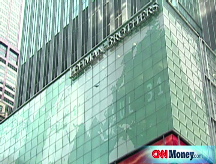

NEW YORK (CNNMoney.com) -- Lehman Brothers has finally announced a path to raising capital. But after Tuesday's 45% plunge in its stock price, it's unclear if Wall Street will let chief executive officer Richard Fuld carry out the plan.
Lehman's (LEH, Fortune 500) stock was down about 2% late Wednesday morning after the company said it would slash its dividend, look for a buyer of the majority of its Neuberger Berman investment management unit and spin off part of its commercial real estate business.
Shares are trading at their lowest point in 10 years, having plummeted nearly 90% so far this year. And by the way, the company lost $3.9 billion in the third quarter.
So now, the natural question that needs to be asked is this: On the heels of the Treasury Department's takeover of mortgage giants Fannie Mae (FNM, Fortune 500) and Freddie Mac (FRE, Fortune 500), does the government now have to step in and bailout Lehman as well.
Unfortunately, it may have no choice.
The Federal Reserve set a dangerous precedent in March when it helped engineer the takeover of Bear Stearns by JPMorgan Chase (JPM, Fortune 500) by agreeing to guarantee $29 billion in potential losses.
Since then, several Fed members, most notably chief Ben Bernanke, have gone out of their way to defend the action, arguing that Bear Stearns simply was too big to fail. The repercussions of allowing Bear to collapse could have been catastrophic.
So if Bear was determined to be too big to fail, isn't it likely the Fed would think Lehman is as well?
Probably. That's because Lehman, the fourth-largest investment bank, is bigger than Bear, which was the fifth-largest at the time it nearly imploded.
What's more, Lehman, a bond-trading powerhouse, is even a bigger player in the mortgage-backed securities market than Bear was. So the Fed could easily argue that letting Lehman go under could create even more chaos in the already volatile credit markets.
Yes, Fuld wants to keep the bank independent by taking a piecemeal approach to breaking up the company. But the market may not let him do so.
And until Lehman actually announces that it has, in fact, raised a substantial amount of capital, it's likely that there will be continued pressure on the stock.
If Lehman's stock falls further, it's reasonable to think that some financial institution would take a gamble on buying the company, especially if it could get Lehman through a "takeunder" just as JPMorgan did with Bear.
Some analysts have tossed out investment manager BlackRock (BLK, Fortune 500), British bank HSBC (HBC) and private equity firm Blackstone (BX) as potential bidders.
But why would any of them agree to take on all the risk without some assurance from the Fed? After all, that's exactly what JPMorgan got in the Bear deal.
Don't get me wrong. I don't like the notion of big Wall Street firms getting saved after making irresponsible, reckless decisions. In what's supposed to be a free market, companies should be allowed to fail.
But the Fed has already opened Pandora's box. It's too late now to say that Lehman should be left to wither away to nothing while Bear was allowed to escape that fate.
To be sure, if one of the three aforementioned firms were to try and buy Lehman and wanted the Fed's help, this would be more complicated than the JPMorgan takeover. BlackRock and Blackstone aren't banks. And HSBC is not a U.S.-headquartered institution.
Still, Bernanke and Fed vice chairman Tim Geithner have demonstrated a remarkable willingness to be flexible and creative in dealing with the credit crunch. So if they wanted to help someone buy Lehman, one would think they would find a way to get it done.
Like it or not, the age of the bailout is in full swing. 



